The United Kingdom: What It's Famous For, Iconic Landmarks, Regions, History and the Meaning of the Union Jack

The United Kingdom packs a remarkable amount into a small corner of north-west Europe: four nations, thousands of years of history, a monarchy that stretches back more than a thousand years, and a cultural influence felt in almost every country on earth. In this guide you will find what the UK is famous for, its most distinctive landmarks, the most popular regions of England, Scotland, Wales and Northern Ireland and what each one offers, a timeline of British history, and the meaning behind the crosses of the Union Jack.
The United Kingdom at a glance
- Full name: the United Kingdom of Great Britain and Northern Ireland
- Capital: London
- Population: around 69 million
- The four nations: England, Scotland, Wales and Northern Ireland, each with its own capital: London, Edinburgh, Cardiff and Belfast
- Head of state: King Charles III
- Languages: English, with Welsh, Scottish Gaelic, Scots, Irish, Ulster Scots and Cornish also spoken
- Currency: the pound sterling (£)
- Highest mountain: Ben Nevis, Scotland (1,345 m)
- Longest river: the River Severn (about 354 km)
- Patron saints' days: St David (Wales) 1 March, St Patrick (Northern Ireland) 17 March, St George (England) 23 April and St Andrew (Scotland) 30 November
What is the United Kingdom famous for?
The Royal Family
The British monarchy is one of the oldest in the world, and its ceremonies draw visitors from every continent. The Changing of the Guard at Buckingham Palace, Trooping the Colour and royal weddings and coronations are watched by millions. Queen Elizabeth II, who reigned for 70 years from 1952 to 2022, was the longest-reigning monarch in British history. Her son, King Charles III, was crowned at Westminster Abbey in 2023.
Tea, pubs and comfort food
The British are famous for their love of tea, and are estimated to drink around 100 million cups a day. Afternoon tea, with sandwiches, scones, clotted cream and jam, became fashionable in the 1840s. The traditional pub is the heart of community life, and classic dishes include fish and chips, the full English breakfast, the Sunday roast, Cornish pasties and Scotland's haggis. Chicken tikka masala is often called a national favourite, a reminder of how much the UK's food has been shaped by the communities who made it their home.
The home of modern sport
Many of the world's favourite sports were codified in Britain. The Football Association drew up the first set of rules for football in 1863, and today the Premier League is the most-watched football league on the planet. Rugby takes its name from Rugby School in England. Cricket's laws are still kept by the Marylebone Cricket Club in London. Wimbledon, first held in 1877, is the oldest tennis tournament in the world, and St Andrews in Scotland is known as the Home of Golf.
Literature and storytelling
William Shakespeare, Jane Austen, Charles Dickens, the Brontë sisters, Robert Burns, Dylan Thomas and C. S. Lewis are just the start. The UK gave the world Sherlock Holmes, James Bond, Middle-earth, Narnia and Harry Potter, and Agatha Christie is recognised as the best-selling fiction writer of all time.
Music that changed the world
From The Beatles, the best-selling music act in history, to the Rolling Stones, Queen, David Bowie, Elton John, Amy Winehouse, Adele and Ed Sheeran, British artists have shaped popular music for more than 60 years. Add Welsh male voice choirs, Scottish bagpipes and Northern Irish folk, and the UK's musical range is enormous.
Inventions and discoveries
Britain was the birthplace of the Industrial Revolution. Isaac Newton described gravity, Charles Darwin developed the theory of evolution by natural selection, and Alexander Fleming discovered penicillin in 1928. Scottish-born Alexander Graham Bell invented the telephone, John Logie Baird demonstrated television in 1926, the world's first public steam railway opened in 1825, and Sir Tim Berners-Lee invented the World Wide Web in 1989.
Ancient universities and parliamentary democracy
The University of Oxford, where teaching existed by 1096, is the oldest university in the English-speaking world, followed by Cambridge in 1209. The UK's Parliament at Westminster is often called the "Mother of Parliaments", and its roots go back to Magna Carta in 1215, the charter that established the principle that even the king was subject to the law.
London's icons
Red double-decker buses, black cabs, red telephone boxes and the chimes of Big Ben are recognised around the world as symbols of Britain.
The UK's most distinctive landmarks
The Palace of Westminster and Big Ben, London
Rising beside the River Thames, the Palace of Westminster is home to the UK Parliament. The building you see today was designed by Charles Barry and Augustus Pugin after a fire destroyed most of the old palace in 1834. Strictly speaking, Big Ben is the name of the great bell inside the clock tower; the tower itself was renamed the Elizabeth Tower in 2012 to mark Queen Elizabeth II's Diamond Jubilee. Together with neighbouring Westminster Abbey, where English and British monarchs have been crowned since 1066, it is a UNESCO World Heritage Site.
The Tower of London

William the Conqueror began building the White Tower around 1078, and over the centuries the Tower of London has served as a royal palace, prison, armoury, treasury and even a zoo. Today it guards the Crown Jewels, is watched over by the Yeoman Warders, known as Beefeaters, and is home to a group of resident ravens. Legend says that if the ravens ever leave, the kingdom will fall.
Stonehenge, Wiltshire

Built in stages from around 3000 BC, Stonehenge is the most famous prehistoric monument in Europe. Its great sarsen stones were raised around 2500 BC, while its smaller bluestones were brought some 240 km from the Preseli Hills in west Wales, a staggering feat for a prehistoric society. The monument is aligned with the sunrise on the summer solstice and the sunset on the winter solstice, and thousands still gather here to mark the longest day.
Edinburgh Castle, Scotland

Perched on Castle Rock, the plug of an extinct volcano, Edinburgh Castle dominates the skyline of Scotland's capital. It contains St Margaret's Chapel, the oldest building in Edinburgh, dating from the 12th century, and the Honours of Scotland, the oldest crown jewels in the British Isles. From Monday to Saturday, the One O'Clock Gun is fired from its walls.
Hadrian's Wall, northern England

In AD 122, the Roman Emperor Hadrian ordered a wall built across the north of Britain to mark the edge of his empire. It ran for about 117 km (73 miles) from the River Tyne to the Solway Firth, with forts and milecastles along its length, and is now part of the Frontiers of the Roman Empire UNESCO World Heritage Site. Despite a common belief, the wall does not mark the border between England and Scotland: it lies entirely within England.
The Roman Baths, Bath

The Romans built a temple and bathing complex around Britain's hottest natural springs in the first century AD, naming the town Aquae Sulis. Water still rises here at around 46°C. The whole city of Bath, with its golden Georgian crescents and terraces where Jane Austen once lived, is a UNESCO World Heritage Site.
Caernarfon Castle, Wales

King Edward I of England began Caernarfon Castle in 1283 after his conquest of Wales. Its distinctive many-sided towers and bands of coloured stone make it one of the most impressive medieval castles in Europe. In 1969 it hosted the investiture of the then Prince Charles as Prince of Wales. It is part of a UNESCO World Heritage Site, together with Edward's other great castles in north Wales.
The White Cliffs of Dover

Rising to around 110 m above the English Channel, the chalk cliffs of Dover are the first sight of England for travellers crossing from France, just 33 km away at the narrowest point. Formed from the remains of tiny marine organisms over millions of years, they became a symbol of home and hope during the Second World War, celebrated in Vera Lynn's famous song "(There'll Be Bluebirds Over) The White Cliffs of Dover".
The four nations and most popular regions of the UK
The United Kingdom is made up of four nations, each with its own identity, traditions and landscapes. These are the regions visitors love most.
England
London

The UK's capital is one of the world's great cities, home to around 9 million people and more than 300 languages. Its national museums, including the British Museum, the Natural History Museum and Tate Modern, are free to enter. Highlights include Buckingham Palace, the West End's theatres, Borough Market and Tower Bridge, opened in 1894, which is often mistaken for London Bridge. Windsor Castle, the oldest and largest occupied castle in the world, is less than an hour away.
Cornwall

England's far south-west is a land of golden beaches, fishing harbours and surf. Cornwall has its own Celtic language and a proud mining heritage, recognised by UNESCO. Visitors come for the artists' town of St Ives, the Eden Project, the dramatic cliffs of Land's End and the famous Cornish pasty. Off the coast at Marazion stands St Michael's Mount, a tidal island crowned by a medieval castle that you can walk to across a causeway at low tide.
The Lake District, Cumbria

England's largest national park and a UNESCO World Heritage Site, the Lake District inspired the poet William Wordsworth and the author Beatrix Potter. It is home to Windermere, England's largest natural lake, and Scafell Pike, England's highest mountain at 978 m. Its fells, lakes and stone villages make it one of the best places in Britain for walking.
The Cotswolds

Rolling green hills, dry stone walls and honey-coloured limestone villages make the Cotswolds the picture of rural England. It is the largest protected landscape of its kind in England, and its towns grew rich on the medieval wool trade. Favourite stops include Bibury, with its famous Arlington Row of 17th-century weavers' cottages, Bourton-on-the-Water and Castle Combe.
Yorkshire

England's largest historic county is known to locals as God's Own County. The city of York was founded by the Romans as Eboracum and later became the Viking city of Jorvik. Its magnificent York Minster, completed in 1472 after 250 years of building, is one of the largest Gothic cathedrals in northern Europe, and its medieval Shambles is one of the best-preserved old streets in Britain. Beyond the city lie the Yorkshire Dales and North York Moors national parks and the seaside town of Whitby, which inspired Dracula.
Scotland
Edinburgh and Glasgow
Scotland's capital, Edinburgh, combines a medieval Old Town and an elegant Georgian New Town, together a UNESCO World Heritage Site. Walk the Royal Mile from the castle to the Palace of Holyroodhouse, climb Arthur's Seat for views across the city, and visit in August for the Edinburgh Festival Fringe, the largest arts festival in the world. An hour west, Glasgow, Scotland's largest city, is famous for its architecture by Charles Rennie Mackintosh, its free museums and a live music scene that earned it the title of UNESCO City of Music.
The Scottish Highlands and the Isle of Skye

The Highlands are Scotland at its wildest: mountains, glens, lochs and castles. Here you will find Ben Nevis, the UK's highest mountain, the dramatic valley of Glencoe, and Loch Ness, which holds more fresh water than all the lakes in England and Wales combined, and is said to be home to the elusive Nessie. The North Coast 500 road trip loops around the far north, while the Isle of Skye offers some of the most spectacular scenery in Europe, including the rock pinnacles of the Old Man of Storr. Scotland's whisky distilleries are an attraction in their own right.
Wales
Eryri (Snowdonia) and north Wales

Eryri National Park is home to Yr Wyddfa (Snowdon), the highest mountain in Wales at 1,085 m, which you can climb on foot or reach by the Snowdon Mountain Railway, opened in 1896. Wales is often said to have more castles per square mile than anywhere else in Europe, and north Wales holds some of the finest, including Caernarfon, Conwy and Harlech. The Welsh language is spoken widely here.
Cardiff and south-west Wales
Cardiff, the Welsh capital, is a lively waterfront city with a castle at its heart and the Principality Stadium, home of Welsh rugby, in its centre. Further west, the Pembrokeshire Coast National Park protects some of Britain's most beautiful beaches, cliffs and islands, and the tiny city of St Davids, with its great cathedral, is the smallest city in the UK.
Northern Ireland
Belfast and the Causeway Coast

Belfast was once one of the great shipbuilding cities of the world, and the Titanic was built in its Harland & Wolff shipyard. The award-winning Titanic Belfast museum now stands beside the slipways where she was constructed. North of the city, the Causeway Coastal Route leads to the Giant's Causeway, a UNESCO World Heritage Site of around 40,000 basalt columns, the Carrick-a-Rede rope bridge and the Dark Hedges, made famous by Game of Thrones, much of which was filmed in Northern Ireland.
A timeline of British history
- c. 900,000 years ago: Early humans leave footprints on the shore at Happisburgh in Norfolk, the oldest known human footprints outside Africa.
- c. 6500 BC: Rising seas flood the land bridge to mainland Europe, and Britain becomes an island.
- c. 3180 BC: People begin living at Skara Brae in Orkney, one of the best-preserved Neolithic villages in Europe.
- c. 3000–2500 BC: Stonehenge is built in stages on Salisbury Plain.
- 43 AD: The Romans invade Britain under the Emperor Claudius.
- 122 AD: Construction of Hadrian's Wall begins.
- c. 410: Roman rule in Britain comes to an end.
- 5th–6th centuries: Anglo-Saxon peoples settle in what becomes England.
- 597: St Augustine arrives in Kent to convert the Anglo-Saxons to Christianity.
- 793: Vikings raid the monastery at Lindisfarne, beginning the Viking Age in Britain.
- 871–899: Alfred the Great, King of Wessex, resists the Vikings.
- 927: Æthelstan becomes the first king of a united England.
- 1066: William of Normandy defeats King Harold at the Battle of Hastings and is crowned at Westminster Abbey.
- 1086: The Domesday Book records the land and wealth of England.
- 1215: King John agrees to Magna Carta at Runnymede.
- 1283: Edward I completes his conquest of Wales and begins building his great castles.
- 1314: Robert the Bruce defeats the English at the Battle of Bannockburn, a decisive step towards Scottish independence, recognised by England in 1328.
- 1348–1349: The Black Death kills between a third and a half of the population.
- 1485: Henry Tudor wins the Battle of Bosworth and becomes King Henry VII.
- 1534: Henry VIII breaks with the Roman Catholic Church and becomes head of the Church of England.
- 1536–1543: The Laws in Wales Acts unite Wales with England.
- 1588: The Spanish Armada is defeated.
- 1603: The Union of the Crowns: James VI of Scotland becomes James I of England.
- 1605: The Gunpowder Plot to blow up Parliament fails, still remembered every 5 November on Bonfire Night.
- 1642–1651: The Civil Wars. King Charles I is executed in 1649, and the monarchy is restored in 1660.
- 1666: The Great Fire of London destroys much of the city.
- 1688–1689: The Glorious Revolution and the Bill of Rights establish the power of Parliament.
- 1707: The Acts of Union join England and Scotland to form the Kingdom of Great Britain.
- c. 1760–1840: The Industrial Revolution transforms Britain into the world's first industrial nation.
- 1801: Union with Ireland creates the United Kingdom of Great Britain and Ireland, and the Union Flag takes its current form.
- 1805: Admiral Nelson's fleet wins the Battle of Trafalgar.
- 1815: The Duke of Wellington defeats Napoleon at Waterloo.
- 1837–1901: The reign of Queen Victoria, as the British Empire reaches its height.
- 1914–1918: The First World War.
- 1918: Some women over 30 win the right to vote; in 1928 the vote is extended to all women over 21.
- 1922: Most of Ireland leaves the United Kingdom as the Irish Free State; in 1927 the country's name becomes the United Kingdom of Great Britain and Northern Ireland.
- 1939–1945: The Second World War, including the Battle of Britain in 1940.
- 1948: The National Health Service is founded, providing healthcare free at the point of use.
- 1953: The coronation of Queen Elizabeth II.
- 1966: England wins the FIFA World Cup at Wembley.
- 1973: The UK joins the European Economic Community.
- 1998: The Good Friday Agreement brings peace to Northern Ireland.
- 1999: The Scottish Parliament and the National Assembly for Wales (now the Senedd) open, as power is devolved from Westminster.
- 2012: London hosts the Olympic and Paralympic Games.
- 2014: Scotland votes to remain part of the UK in an independence referendum.
- 2020: The UK leaves the European Union, following the 2016 referendum.
- 2022: Queen Elizabeth II dies after 70 years on the throne, and King Charles III becomes king.
- 2023: King Charles III is crowned at Westminster Abbey.
The Union Jack: its history and meaning
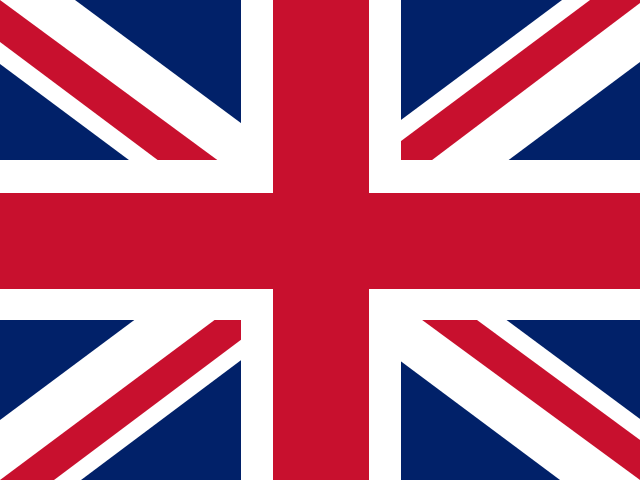
The flag of the United Kingdom, known as the Union Flag or Union Jack, is one of the most recognisable flags in the world. It is literally a union of flags: it combines the crosses of three patron saints to represent the nations brought together under one crown.
What the crosses mean
- The red cross of St George on a white background represents England.
- The white diagonal cross (saltire) of St Andrew on a blue background represents Scotland.
- The red saltire of St Patrick on a white background represents Ireland, today Northern Ireland.
Layered together, they show the nations of the UK joined under a single flag.
Where the flag came from
When James VI of Scotland also became James I of England in 1603, his two kingdoms shared a monarch but kept their own flags. In 1606 a royal proclamation created the first Union Flag, combining the cross of St George and the saltire of St Andrew, for use on ships. When Great Britain and Ireland were united on 1 January 1801, the red saltire of St Patrick was added, creating the design still flown today.
Why isn't Wales on the Union Jack?
Wales is not represented because, when the first Union Flag was created in 1606, Wales was already united with England and was treated as part of the Kingdom of England. Wales has its own flag, Y Ddraig Goch, the Red Dragon on a field of green and white, a symbol with roots more than a thousand years old.
Flag facts most people get wrong
- Union Jack or Union Flag? Both names are widely accepted. One popular explanation is that "jack" referred to a small flag flown at the bow of a ship, and "Union Jack" is now the name used around the world.
- It can be flown upside down. The flag is not symmetrical. In the upper corner nearest the flagpole, the broad white diagonal stripe should be above the red one.
- It was never adopted by law. The Union Flag has never been made the national flag by an Act of Parliament; it holds that role through long-established tradition.
- It appears on other flags. The Union Jack features on the flags of Australia, New Zealand, Fiji and Tuvalu, and on the state flag of Hawaii.
The British people: identity, diversity and spirit
Ask someone from the UK where they are from, and they may well say English, Scottish, Welsh or Northern Irish before they say British. Each nation has its own traditions, languages, sports teams and fierce sense of pride, from Welsh rugby and Scottish Highland games to English village fêtes and Northern Irish music.
Centuries of trade, empire and migration have also made the UK one of the most diverse countries in the world, and its cities are home to communities from every continent. That mix is reflected in everything from its food and music to its festivals, such as London's Notting Hill Carnival, one of the largest street festivals in Europe.
The British are known for their understated humour, their famous love of queueing and talking about the weather, and a deep attachment to institutions such as the NHS. And through the Commonwealth of Nations, a voluntary association of 56 countries, the UK keeps close ties with nations around the world.
Frequently asked questions about the United Kingdom
What is the United Kingdom most famous for?
The UK is famous for the Royal Family, landmarks such as Big Ben, the Tower of London and Stonehenge, its tea and pubs, football and other sports it codified, writers from Shakespeare to J. K. Rowling, music from The Beatles to Adele, and its landscapes, from the Scottish Highlands to the Cornish coast.
What is the difference between the UK, Great Britain and England?
England is one of the four nations of the UK. Great Britain is the island that contains England, Scotland and Wales. The United Kingdom is the country made up of Great Britain and Northern Ireland.
What do the crosses on the Union Jack mean?
The red cross of St George represents England, the white saltire of St Andrew represents Scotland, and the red saltire of St Patrick represents Ireland.
Why is Wales not on the Union Jack?
When the first Union Flag was created in 1606, Wales was already united with England and was treated as part of the Kingdom of England, so it was not represented separately.
Is it called the Union Jack or the Union Flag?
Both names are commonly used and widely accepted. "Union Jack" is the more popular name around the world.
What is the oldest landmark in the United Kingdom?
Among the oldest is Skara Brae in Orkney, a Neolithic village first lived in around 3180 BC. The earliest phase of Stonehenge dates to around 3000 BC.
Own a square of the Union Jack
On 195 Flags, the flag of the United Kingdom is being rebuilt one square at a time by people from England, Scotland, Wales, Northern Ireland and British communities around the world. Claim your square for $1.99 and seal a message and a photo inside it: a time capsule for your future self and the generations who come after you. And when the UK flag is completely filled, one square owner wins $40,000.
Claim your square of the UK flag →
Photo credits
- Palace of Westminster (cover): Diliff, CC BY-SA 2.5, via Wikimedia Commons
- Tower of London: Bob Collowan, CC BY-SA 3.0, via Wikimedia Commons
- Stonehenge: Diego Delso, CC BY-SA 4.0, via Wikimedia Commons
- Edinburgh Castle: John Lord, CC BY-SA 2.0, via Wikimedia Commons
- Hadrian's Wall: Benjamin Smith, CC BY-SA 4.0, via Wikimedia Commons
- The Roman Baths, Bath: Suicasmo, CC BY-SA 4.0, via Wikimedia Commons
- Caernarfon Castle: Herbert Ortner, CC BY 4.0, via Wikimedia Commons
- The White Cliffs of Dover: Tanya Dedyukhina, CC BY 3.0, via Wikimedia Commons
- Tower Bridge, London: Dietmar Rabich, CC BY-SA 4.0, via Wikimedia Commons
- St Michael's Mount, Cornwall: Hugh Llewelyn, CC BY-SA 2.0, via Wikimedia Commons
- Derwentwater, Lake District: Julian Herzog (Website), CC BY 4.0, via Wikimedia Commons
- Arlington Row, Bibury: Saffron Blaze, CC BY-SA 3.0, via Wikimedia Commons
- York Minster: Can Pac Swire, CC BY-SA 2.0, via Wikimedia Commons
- Old Man of Storr, Isle of Skye: Lauwz The Kiwistralian, CC0, via Wikimedia Commons
- Yr Wyddfa (Snowdon), Eryri: Julian Herzog (Website), CC BY 4.0, via Wikimedia Commons
- Titanic Belfast: Suicasmo, CC BY-SA 4.0, via Wikimedia Commons


_20140310.jpg)

.jpg)


The Union Flag image is from 195flags.com.