The USA: What It's Famous For, Iconic Landmarks, Top States, History and the Meaning of the American Flag

Few countries are as instantly recognisable as the United States of America. Its films, music, food, sport and technology reach every corner of the planet, and its landscapes range from Arctic tundra and tropical islands to deserts, canyons and some of the most famous city skylines on earth. In 2026 the USA celebrated 250 years of independence, making this the perfect moment to explore what the country is famous for, its most iconic landmarks, the most popular states and what each one offers, a timeline of American history, and the meaning behind the stars and stripes of the American flag.
The USA at a glance
- Official name: the United States of America
- Capital: Washington, D.C.; the largest city is New York City
- Population: around 340 million, the third-largest population in the world
- States: 50 states, plus the federal district of Washington, D.C. and five inhabited territories, including Puerto Rico and Guam
- Area: around 9.8 million km², one of the largest countries on earth
- Language: English, designated the official language by presidential executive order in 2025, with Spanish also widely spoken
- Currency: the US dollar ($)
- National symbols: the bald eagle, the Stars and Stripes, the motto "In God We Trust" and the anthem "The Star-Spangled Banner"
- National day: Independence Day, 4 July
- Highest mountain: Denali, Alaska (6,190 m), the highest peak in North America
- Longest river: the Missouri River (about 3,770 km)
- Lowest point: Badwater Basin in Death Valley, California (86 m below sea level)
What is the USA famous for?
Hollywood and entertainment
Since the 1910s, Hollywood in Los Angeles has been the centre of the American film industry, and its movies, stars and the Academy Awards, first held in 1929, are known worldwide. Add Broadway's musicals, Disney's theme parks and America's television series and streaming shows, and it is easy to see why the USA is often called the entertainment capital of the world.
The birthplace of modern music
An extraordinary number of music genres were born in the USA, many of them created by African American musicians. Jazz grew up in New Orleans, the blues came out of the Mississippi Delta, country music took root in Appalachia and Nashville, rock and roll exploded in the 1950s, and hip hop was born at a block party in the Bronx in 1973. From Louis Armstrong and Elvis Presley to Michael Jackson, Beyoncé and Taylor Swift, American artists have shaped what the world listens to.
Sport on a giant scale
The Super Bowl, the final of American football's NFL, is the most-watched television event in the USA every year. Baseball is known as "America's pastime", and basketball was invented in 1891 by James Naismith in Springfield, Massachusetts. The USA has won more Olympic medals than any other country, co-hosted the FIFA World Cup in 2026 with Canada and Mexico, and will host the Summer Olympics in Los Angeles in 2028.
Technology, innovation and space
From Thomas Edison's practical light bulb and the Wright brothers' first powered flight in 1903 to the personal computer and the smartphone, American inventors have changed daily life. California's Silicon Valley is the global heart of the tech industry, home to many of the world's best-known technology companies. And in 1969, Apollo 11 made the USA the only country to land astronauts on the Moon; twelve Americans walked on its surface between 1969 and 1972.
Food
Hamburgers, hot dogs, apple pie, fried chicken and Thanksgiving turkey are American classics, but the country's food is wonderfully regional: Texas and Memphis barbecue, Tex-Mex, New York pizza, Chicago deep-dish, New England clam chowder, Louisiana gumbo and Maine lobster rolls, each shaped by the people who settled there.
National parks and the great road trip
In 1872, Yellowstone became the world's first national park, and the USA now has 63 of them, protecting everything from glaciers to coral reefs. Road trips are part of the American way of life, and the most famous route of all, Route 66, which runs for about 3,940 km from Chicago to Santa Monica, celebrates its 100th birthday in 2026.
Holidays and traditions
Fireworks on the Fourth of July, turkey dinners on Thanksgiving, trick-or-treating at Halloween and the Times Square ball drop on New Year's Eve are American traditions now copied around the world.
A nation of immigrants
Between 1892 and 1954, around 12 million immigrants entered the USA through Ellis Island in New York Harbor, and millions more arrived through other ports. Today the USA is home to more immigrants than any other country, and that mix of cultures is at the heart of American life.
The USA's most iconic landmarks
The Statue of Liberty, New York
A gift from the people of France, the Statue of Liberty was dedicated on 28 October 1886. Designed by the sculptor Frédéric Auguste Bartholdi, with an internal iron framework engineered by Gustave Eiffel, it stands about 93 m from the ground to the tip of its torch. Lady Liberty holds a tablet inscribed with the date of the Declaration of Independence, 4 July 1776, and broken chains lie at her feet. Her copper skin was once a shiny brown, but weathered to its famous green within a few decades. For millions of immigrants arriving by ship, she was their first sight of America, and she is now a UNESCO World Heritage Site.
The Grand Canyon, Arizona

Carved by the Colorado River over millions of years, the Grand Canyon is about 446 km long, up to 29 km wide and more than 1.8 km deep. The oldest rocks at the bottom of the canyon are nearly two billion years old. It became a national park in 1919 and a UNESCO World Heritage Site in 1979, and it remains sacred to Native American peoples including the Havasupai, Hopi and Navajo.
The Golden Gate Bridge, San Francisco

When it opened in 1937, the Golden Gate Bridge had the longest main span of any suspension bridge in the world, at 1,280 m. Painted a colour known as "International Orange", it stands out beautifully against San Francisco's famous fog and has become one of the most photographed bridges on the planet.
Mount Rushmore, South Dakota

Carved into the granite of the Black Hills between 1927 and 1941, Mount Rushmore shows four presidents: George Washington, Thomas Jefferson, Theodore Roosevelt and Abraham Lincoln. Each face is about 18 m tall. The Black Hills are sacred to the Lakota Sioux, and nearby the Crazy Horse Memorial, honouring the Lakota leader, has been under construction since 1948.
Yellowstone National Park

Established in 1872, Yellowstone covers parts of Wyoming, Montana and Idaho and sits on top of one of the world's largest volcanic systems. It is home to about half of the world's geysers, including Old Faithful, which erupts roughly every hour and a half, and the Grand Prismatic Spring, the largest hot spring in the USA, whose rainbow colours come from heat-loving microbes. Bison, wolves, elk and grizzly bears roam its valleys.
Washington, D.C. and the National Mall

The National Mall in the US capital links some of the country's most important monuments. The US Capitol is home to Congress, and every president since John Adams in 1800 has lived in the White House. At the Lincoln Memorial, opened in 1922, Martin Luther King Jr. delivered his "I Have a Dream" speech in 1963. The 169 m Washington Monument, completed in 1884, was briefly the tallest structure in the world. Most of the Smithsonian's museums along the Mall are free to enter.
Independence Hall, Philadelphia
The birthplace of the nation, Independence Hall in Philadelphia is where the Declaration of Independence was adopted in 1776 and the US Constitution was drafted in 1787. Across the street hangs the Liberty Bell, with its famous crack. Independence Hall is a UNESCO World Heritage Site, making it a natural place to mark the country's 250th anniversary.
Niagara Falls, New York

On the border between New York State and Ontario, Canada, Niagara Falls is made up of three waterfalls: the Horseshoe Falls, most of which lies in Canada, the American Falls and the smaller Bridal Veil Falls. Boat tours have carried visitors into the spray at the foot of the falls since the 1840s, and Niagara Falls State Park, created in 1885, is the oldest state park in the USA.
The most popular states in the USA and what they offer
With 50 states, the USA is almost like 50 countries in one. These are the states visitors love most.
New York

New York City, "the Big Apple", is spread across five boroughs: Manhattan, Brooklyn, Queens, the Bronx and Staten Island. Times Square, Central Park, the Empire State Building, Broadway's theatres, the Metropolitan Museum of Art and the 9/11 Memorial are all here, and One World Trade Center rises to a symbolic 1,776 feet, the year of independence. Beyond the city, New York State offers Niagara Falls, the Adirondack Mountains and the Hudson Valley.
California

The most populous state, with around 39 million people, California would be one of the largest economies in the world if it were a country. It has Hollywood and Los Angeles, San Francisco, Silicon Valley, the wine country of Napa Valley and the dramatic Big Sur coastline. In Yosemite National Park, granite giants like El Capitan and Half Dome tower over the valley, and the state's coast redwoods are the tallest trees on earth. Death Valley holds the record for the hottest air temperature ever measured, 56.7°C in 1913.
Florida

The Sunshine State is home to Walt Disney World, which opened near Orlando in 1971 and is one of the most visited holiday resorts in the world. Miami Beach has one of the largest collections of Art Deco architecture anywhere, the Everglades are the largest subtropical wilderness in the USA, and the Kennedy Space Center at Cape Canaveral is where Apollo 11 set off for the Moon. At the end of the Florida Keys lies Key West, the southernmost city in the continental USA.
Texas

The second-largest state by both area and population, Texas was an independent republic from 1836 to 1845, which is why it is called the Lone Star State. In San Antonio you can visit the Alamo, site of the famous 1836 battle, and stroll the River Walk. Austin calls itself the Live Music Capital of the World, Houston is home to NASA's mission control, and Texas barbecue and Tex-Mex food are legendary. Out west, Big Bend National Park offers desert, mountains and canyons.
Hawaii

The 50th state, which joined the union in 1959, Hawaii is the only state made up entirely of islands and the only one outside North America. It offers volcanoes, including Kīlauea, one of the most active on earth, the towering cliffs of Kauai's Na Pali Coast, the beaches of Waikiki and the history of Pearl Harbor, attacked on 7 December 1941. Hawaii is the birthplace of modern surfing, and its state flag even includes the Union Jack.
Alaska

By far the largest state, Alaska is more than twice the size of Texas. The USA bought it from Russia in 1867 for $7.2 million, about two cents an acre, and it became the 49th state in 1959. Alaska is home to Denali, the highest mountain in North America, vast glaciers, bears, moose and whales, the northern lights in winter and the midnight sun in summer.
Illinois (Chicago)

Chicago, the "Windy City", is the birthplace of the skyscraper: the world's first, the Home Insurance Building, went up here in 1885. Today visitors take architecture boat tours along the Chicago River, photograph themselves in Cloud Gate, nicknamed "The Bean", and eat deep-dish pizza. Chicago is also a capital of the blues and the starting point of Route 66.
Louisiana (New Orleans)

Founded by the French in 1718, New Orleans is the birthplace of jazz and one of the most distinctive cities in the USA. Its French Quarter is famous for wrought-iron balconies, live music and the street parades of Mardi Gras. Creole and Cajun cooking, from gumbo and jambalaya to beignets, make it one of the country's great food cities.
Nevada (Las Vegas)

Las Vegas, the "Entertainment Capital of the World", rose out of the Nevada desert to become a city of giant casino resorts, shows, concerts and nightlife along the famous Strip. Nearby, the Hoover Dam, completed in 1936 on the Nevada–Arizona border, created Lake Mead, the largest reservoir in the USA, and Red Rock Canyon offers desert hiking just minutes from the city.
Arizona and Utah: canyon country

The American Southwest is a land of red rock and big skies. Beyond the Grand Canyon, Arizona offers the red rocks of Sedona and the slot canyons of Antelope Canyon, while Monument Valley, a Navajo Tribal Park on the Arizona–Utah border, became the backdrop for countless Western films. Utah's "Mighty Five" national parks, Zion, Bryce Canyon, Arches, Canyonlands and Capitol Reef, are among the most spectacular in the country.
Massachusetts
Massachusetts is where the American Revolution began. In Boston, the 4 km Freedom Trail links 16 historic sites, from Paul Revere's house to the Old North Church, and the city was the scene of the Boston Tea Party in 1773. Nearby Cambridge is home to Harvard, founded in 1636 as the oldest university in the USA, while Plymouth marks the landing of the Mayflower in 1620 and Cape Cod offers beaches and lighthouses.
Tennessee
Tennessee is a pilgrimage for music lovers. Nashville, "Music City", is the home of country music and the Grand Ole Opry, broadcast since 1925. In Memphis, you can hear the blues on Beale Street, tour Elvis Presley's Graceland, visit Sun Studio, where rock and roll took shape, and reflect at the National Civil Rights Museum. The Great Smoky Mountains National Park, shared with North Carolina, is the most visited national park in the USA.
A timeline of American history
- More than 20,000 years ago: The first people arrive in the Americas; human footprints at White Sands in New Mexico are dated to this time.
- c. 1050–1150: Cahokia, near present-day St. Louis, is the largest city in North America north of Mexico.
- c. 1190–1280: Ancestral Puebloans build the cliff dwellings of Mesa Verde in Colorado.
- 1492: Christopher Columbus reaches the Caribbean, beginning European colonisation of the Americas.
- 1565: The Spanish found St. Augustine in Florida, the oldest continuously inhabited European-founded city in the continental USA.
- 1607: Jamestown, Virginia, becomes the first permanent English settlement in North America.
- 1619: The first recorded enslaved Africans arrive in English Virginia.
- 1620: The Pilgrims arrive on the Mayflower and found Plymouth Colony.
- 1754–1763: The French and Indian War is fought between Britain and France for control of North America.
- 1773: Colonists protest British taxes at the Boston Tea Party.
- 1775: The American Revolutionary War begins at Lexington and Concord.
- 1776: On 4 July, the Continental Congress adopts the Declaration of Independence.
- 1783: The Treaty of Paris ends the war, and Britain recognises American independence.
- 1787: The US Constitution is written in Philadelphia.
- 1789: George Washington becomes the first president; the Bill of Rights follows in 1791.
- 1803: The Louisiana Purchase from France doubles the size of the country.
- 1804–1806: Lewis and Clark explore the West, reaching the Pacific Ocean.
- 1812–1815: The War of 1812 against Britain; Francis Scott Key writes "The Star-Spangled Banner" in 1814.
- 1830s: The Indian Removal Act forces Native American nations from their lands, including the Cherokee on the Trail of Tears.
- 1846–1848: The Mexican–American War ends with the USA gaining vast territories in the West.
- 1848: Gold is discovered in California, sparking the Gold Rush.
- 1861–1865: The Civil War; Abraham Lincoln issues the Emancipation Proclamation in 1863, and the 13th Amendment abolishes slavery in 1865.
- 1869: The first transcontinental railroad is completed in Utah.
- 1872: Yellowstone becomes the world's first national park.
- 1886: The Statue of Liberty is dedicated in New York Harbor.
- 1892: Ellis Island opens as the nation's busiest immigration station.
- 1903: The Wright brothers make the first powered aeroplane flight at Kitty Hawk, North Carolina.
- 1917–1918: The USA fights in the First World War.
- 1920: The 19th Amendment gives women the right to vote.
- 1929: The Wall Street Crash begins the Great Depression.
- 1941: Japan attacks Pearl Harbor on 7 December, and the USA enters the Second World War.
- 1945: The Second World War ends.
- 1954: The Supreme Court rules school segregation unconstitutional in Brown v. Board of Education.
- 1959: Alaska and Hawaii become the 49th and 50th states.
- 1963: Martin Luther King Jr. delivers his "I Have a Dream" speech; President John F. Kennedy is assassinated in November.
- 1964–1965: The Civil Rights Act and the Voting Rights Act are passed.
- 1969: Apollo 11 lands on the Moon, and Neil Armstrong becomes the first person to walk on its surface.
- 1989–1991: The Cold War comes to an end.
- 2001: The September 11 attacks kill nearly 3,000 people.
- 2008: Barack Obama is elected the first African American president.
- 2026: The USA marks 250 years of independence and co-hosts the FIFA World Cup.
The American flag: its history and meaning
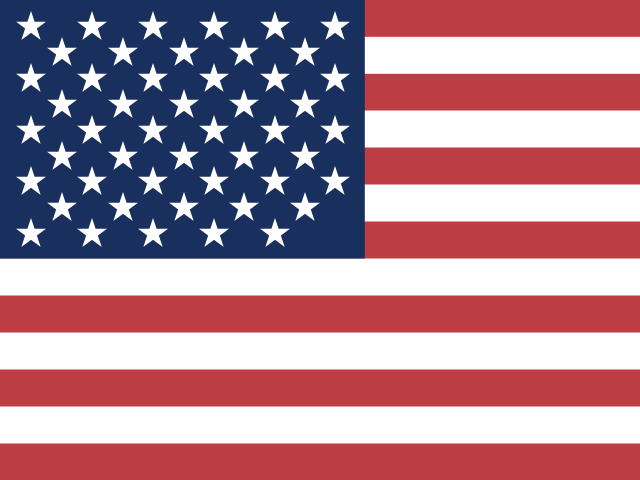
The flag of the United States, known as the Stars and Stripes, Old Glory and the Star-Spangled Banner, is one of the most widely recognised symbols in the world.
What the stars and stripes mean
- The 13 stripes, seven red and six white, represent the 13 original colonies that declared independence from Britain in 1776.
- The 50 white stars on a blue field represent the 50 states of the union.
- The colours were not given an official meaning when the flag was adopted. However, when the same colours were chosen for the Great Seal of the United States in 1782, they were described this way: white for purity and innocence, red for hardiness and valour, and blue for vigilance, perseverance and justice. These meanings are now widely applied to the flag.
Where the flag came from
On 14 June 1777, the Continental Congress resolved that the flag of the United States would have "thirteen stripes, alternate red and white" and "thirteen stars, white in a blue field, representing a new constellation". That date is still celebrated as Flag Day. The popular story that Betsy Ross sewed the first flag is a cherished legend, but historians have never been able to prove it.
As new states joined the union, stars were added. Since 1818, the number of stripes has been fixed at 13, with a new star added on the 4 July after each state's admission. The current 50-star flag, introduced on 4 July 1960 after Hawaii became a state, is the 27th version of the flag and the longest-serving in American history.
Flag facts most people don't know
- "Old Glory" was the name a 19th-century sea captain, William Driver, gave his flag, and it stuck.
- "The Star-Spangled Banner" comes from Francis Scott Key's poem, written after he saw the flag still flying over Fort McHenry in Baltimore after a British bombardment in 1814. It became the national anthem in 1931.
- There are six American flags on the Moon, planted during the Apollo 11, 12, 14, 15, 16 and 17 missions.
- The flag has its own etiquette. Under the US Flag Code, the flag should not touch the ground, is flown at half-staff in times of mourning, and worn-out flags should be retired respectfully, preferably by burning.
The American people: diversity and the American spirit
The United States is home to more than 570 federally recognised Native American tribes, whose nations lived on this land for thousands of years before Europeans arrived. Over the centuries, they were joined by people from every corner of the world: Europeans, enslaved Africans and their descendants, Latin Americans and Asians. African American culture in particular has shaped American music, food, language and the fight for civil rights, while today around one in five Americans is Hispanic or Latino.
That diversity is captured in an old national motto found on the Great Seal, E pluribus unum, "out of many, one". Americans are known for their optimism, their entrepreneurial spirit and the idea of the American Dream: that anyone, from any background, can build a better life through hard work. Regional identities are strong, from Southern hospitality and Midwestern friendliness to the fast pace of New York, but on the Fourth of July the whole country comes together under the Stars and Stripes.
Frequently asked questions about the USA
What is the USA most famous for?
The USA is famous for Hollywood and entertainment, music genres from jazz and blues to rock and roll and hip hop, sports such as American football and basketball, technology and Silicon Valley, the Moon landing, its national parks, and landmarks including the Statue of Liberty, the Grand Canyon and the Golden Gate Bridge.
What do the stars and stripes on the American flag mean?
The 13 stripes represent the 13 original colonies that declared independence in 1776, and the 50 stars represent the 50 states. The red, white and blue are often said to stand for valour, purity and justice.
Why does the US flag have 13 stripes?
The 13 stripes honour the 13 British colonies that declared independence and became the first states of the USA. Since 1818 the number of stripes has stayed at 13, while a star is added for each new state.
How many states are there in the USA?
There are 50 states. Washington, D.C. is a federal district rather than a state, and the USA also has several territories, including Puerto Rico and Guam.
What is the oldest city in the USA?
St. Augustine in Florida, founded by the Spanish in 1565, is the oldest continuously inhabited city founded by Europeans in the continental USA. Some Native American communities, such as Acoma Pueblo and Taos Pueblo in New Mexico, have been lived in for around a thousand years.
Is Washington, D.C. a state?
No. Washington, D.C. is a federal district created to be the seat of the national government. It is not part of any state.
Own a square of the American flag
On 195 Flags, the flag of the United States is being rebuilt one square at a time by Americans at home and around the world. Claim your square for $1.99 and seal a message and a photo inside it: a time capsule for your future self and the generations who come after you. And when the American flag is completely filled, one square owner wins $40,000.
Claim your square of the American flag →
Photo credits
- Statue of Liberty (cover): Christian David, CC BY-SA 4.0, via Wikimedia Commons
- Grand Canyon: Tuxyso, CC BY-SA 3.0, via Wikimedia Commons
- Golden Gate Bridge: Brocken Inaglory, CC BY-SA 3.0, via Wikimedia Commons
- Mount Rushmore: Gs970, CC BY-SA 4.0, via Wikimedia Commons
- Grand Prismatic Spring, Yellowstone: Carsten Steger, CC BY-SA 4.0, via Wikimedia Commons
- National Mall, Washington, D.C.: Mike Peel (www.mikepeel.net), CC BY-SA 4.0, via Wikimedia Commons
- Niagara Falls: Saffron Blaze, CC BY-SA 3.0, via Wikimedia Commons
- Lower Manhattan skyline: Percival Kestreltail, CC BY-SA 3.0, via Wikimedia Commons
- Tunnel View, Yosemite: Diliff, CC BY-SA 3.0, via Wikimedia Commons
- Ocean Drive, Miami Beach: Phillip Pessar, CC BY 4.0, via Wikimedia Commons
- The Alamo, San Antonio: Zygmunt Put Zetpe0202, CC BY-SA 4.0, via Wikimedia Commons
- Na Pali Coast, Kauai: dronepicr, CC BY 2.0, via Wikimedia Commons
- Denali and Wonder Lake: Mary Lewandowski, Public domain, via Wikimedia Commons
- Chicago skyline: Alvesgaspar, CC BY-SA 4.0, via Wikimedia Commons
- French Quarter, New Orleans: Tim Wilson from Blaine, MN, USA, CC BY 2.0, via Wikimedia Commons
- Las Vegas Strip: joannapoe, CC BY-SA 2.0, via Wikimedia Commons
- Monument Valley: Christian Mehlführer, CC BY 2.5, via Wikimedia Commons


.jpg)


.jpg)
.jpg)


.jpg)

The American flag image is from 195flags.com.