Australia: What It's Famous For, Iconic Landmarks, States, History and the Meaning of the Australian Flag

Australia is the only country that covers an entire continent. It is a land of red deserts and tropical rainforests, coral reefs and snowy mountains, golden beaches and cosmopolitan cities, and it is home to the oldest continuous living cultures on earth. In this guide we explore what Australia is famous for, its most distinctive landmarks, the most popular states and territories and what each one offers, a timeline of Australian history, and the meaning behind the stars of the Australian flag.
Australia at a glance
- Official name: the Commonwealth of Australia
- Capital: Canberra; the largest cities are Sydney and Melbourne, which are close in size
- Population: around 28 million
- Area: about 7.7 million km², the sixth-largest country in the world
- Language: English is the national language in practice, although Australia has no official language in law; more than 250 Aboriginal and Torres Strait Islander languages were spoken before colonisation, and many are still spoken today
- Currency: the Australian dollar ($)
- States and territories: 6 states and 2 major mainland territories, plus several external territories
- Government: a federal parliamentary democracy and constitutional monarchy, with King Charles III as head of state
- National symbols: the kangaroo and emu on the coat of arms, the golden wattle, the national colours of green and gold, and the anthem "Advance Australia Fair"
- National day: Australia Day, 26 January, the anniversary of the arrival of the First Fleet in 1788; many Aboriginal and Torres Strait Islander people instead mark the date as a day of mourning or survival
- Highest mountain: Mount Kosciuszko, New South Wales (2,228 m), the highest on the mainland
- Longest river: the Murray River (about 2,500 km)
- Standout facts: Australia is the driest inhabited continent, and most Australians live near the coast
What is Australia famous for?
Unique wildlife
Australia's long isolation produced animals found nowhere else. Kangaroos, koalas, wombats, emus and Tasmanian devils all live here, as do the platypus and the echidna, the world's only egg-laying mammals. Most of the country's mammals, reptiles and frogs are found only in Australia. The country also has a reputation for venomous snakes, spiders and saltwater crocodiles, although serious encounters are rare for visitors who follow local advice.
The oldest continuous living cultures
Aboriginal and Torres Strait Islander peoples have lived in Australia for at least 50,000 years, and possibly more than 65,000, making their cultures the oldest continuous living cultures in the world. Their connection to Country, their stories of the Dreaming, their rock art, dot painting and music, including the didgeridoo of northern Australia, are a profound part of Australian life.
Beaches and the outdoor lifestyle
With more than 10,000 beaches, Australia is famous for surfing, swimming and summer barbecues. Volunteer surf lifesavers in their red and yellow caps have patrolled the beaches for more than a century, and the warm climate means much of life is lived outdoors.
Sport
Australians are passionate about sport. Cricket is a summer obsession, and the Ashes series against England has been contested since 1882–83. Australian rules football (the AFL) dominates in the south and west, while rugby league is hugely popular in New South Wales and Queensland. Melbourne hosts the Australian Open tennis every January and the Melbourne Cup, "the race that stops the nation", every November. Sydney hosted the 2000 Olympics, and Brisbane will host the Games in 2032.
Food and drink
Meat pies, sausage sizzles, lamingtons and Anzac biscuits are Australian classics, and Vegemite, created in Melbourne in 1922, is a breakfast staple. The pavlova and the flat white are proudly claimed by both Australia and New Zealand. Australia's café culture is world famous, especially in Melbourne, and its wine regions, from the Barossa Valley to Margaret River, produce acclaimed shiraz and chardonnay.
Inventions and discoveries
Australian scientists and inventors gave the world the black box flight recorder, developed by David Warren in the 1950s, the multi-channel cochlear implant, pioneered by Graeme Clark, and key technology used in fast Wi-Fi, developed at the national science agency CSIRO. Australian-born Howard Florey shared the 1945 Nobel Prize for turning penicillin into a life-saving medicine, and Google Maps began life in a Sydney start-up.
Music, film and television
From AC/DC, INXS and Kylie Minogue to Sia, Tame Impala and The Wiggles, Australian music has travelled the world. Australian actors such as Nicole Kidman, Cate Blanchett, Hugh Jackman, Margot Robbie and Chris Hemsworth are Hollywood stars, and soap operas like Neighbours and Home and Away found huge audiences in Britain.
Festivals and celebrations
Sydney's New Year's Eve fireworks over the harbour are watched around the world, and the city also hosts Vivid Sydney, a winter festival of light, and the Sydney Gay and Lesbian Mardi Gras. On Anzac Day, 25 April, Australians gather at dawn services to remember those who served in war, beginning with the Gallipoli landings of 1915.
Australia's most distinctive landmarks
The Sydney Opera House and Harbour Bridge
Designed by the Danish architect Jørn Utzon, the Sydney Opera House was opened by Queen Elizabeth II in 1973 and became a UNESCO World Heritage Site in 2007. Its sail-like shells are covered with more than a million tiles. Utzon left the project in 1966 and never returned to see it finished. Next door, the steel arch of the Sydney Harbour Bridge, nicknamed "the Coathanger", opened in 1932, and visitors can climb to the top of its arch, around 134 m above the water.
Uluru, Northern Territory

Rising about 348 m above the surrounding plain in the heart of the Red Centre, Uluru is a vast sandstone formation that seems to change colour through the day, glowing red at sunrise and sunset. It is a sacred place for the Anangu, its traditional owners, and was handed back to them in 1985; the park is now jointly managed by Anangu and Parks Australia. Out of respect for Anangu wishes, climbing Uluru was permanently banned in 2019. Nearby, the 36 domes of Kata Tjuta rise even higher.
The Great Barrier Reef, Queensland

The world's largest coral reef system stretches for about 2,300 km along the coast of Queensland and is made up of around 2,900 individual reefs and hundreds of islands. It is home to thousands of species, including turtles, sharks, dugongs and some 1,500 kinds of fish, and has been a UNESCO World Heritage Site since 1981. Rising sea temperatures have caused several mass coral bleaching events in recent years, and protecting the reef is a major national effort.
The Twelve Apostles, Victoria

The highlight of the Great Ocean Road, which was built by returned soldiers after the First World War as a memorial to their fallen comrades, the Twelve Apostles are limestone stacks carved from the cliffs by the Southern Ocean. Despite the name, there were never twelve of them, and the waves keep reshaping the coast: one stack collapsed in 2005, and only a handful stand today.
Bondi Beach, Sydney

About 1 km of golden sand just a short trip from central Sydney, Bondi is probably Australia's most famous beach. Surfers, swimmers and sunbathers fill it all year round, the ocean pool at Bondi Icebergs is one of the most photographed swimming pools in the world, and the clifftop coastal walk from Bondi to Coogee, about 6 km long, offers spectacular views.
The Blue Mountains, New South Wales

About two hours west of Sydney, the Blue Mountains get their name from the blue haze that hangs over their eucalyptus forests, caused partly by tiny droplets of oil released by the trees. The sandstone pillars of the Three Sisters at Katoomba are the most famous sight, linked to an Aboriginal story, and the wider region is part of the Greater Blue Mountains UNESCO World Heritage Area.
Kakadu National Park, Northern Territory

East of Darwin, Kakadu is a vast national park of wetlands, waterfalls, escarpments and monsoon forest, listed by UNESCO for both its natural and cultural value. Its rock art sites, such as Ubirr and Burrungkuy (Nourlangie), record thousands of years of Aboriginal history. The park is jointly managed with its traditional owners, the Bininj/Mungguy people, and is home to saltwater crocodiles and a huge variety of birds.
Parliament House, Canberra

Canberra was purpose-built as the national capital, a compromise between rivals Sydney and Melbourne, and was designed by the American architects Walter Burley Griffin and Marion Mahony Griffin. Parliament House, opened in 1988 for Australia's bicentenary, is built into Capital Hill and crowned by a giant flagpole about 81 m tall. Visitors can tour the building and watch Parliament in session.
The most popular states and territories in Australia and what they offer
Australia is made up of six states and two mainland territories, each with its own landscapes and personality.
New South Wales
Australia's most populous state is home to Sydney, with its harbour, the Opera House, Bondi and dozens of other beaches, and neighbourhoods from The Rocks to Manly. Beyond the city are the Blue Mountains, the wineries of the Hunter Valley, the laid-back coastal town of Byron Bay, near the most easterly point of the Australian mainland, and the snowfields around Mount Kosciuszko. Lord Howe Island, a UNESCO-listed island in the Tasman Sea, is also part of the state.
Victoria

Melbourne, the seat of Australia's federal Parliament from 1901 to 1927, is known for its laneways, street art, coffee, food and arts scene, and its love of sport: the Melbourne Cricket Ground holds around 100,000 people. Its grand Flinders Street Station is one of the city's best-loved buildings. Outside the city, visitors can drive the Great Ocean Road, watch little penguins waddle ashore on Phillip Island, taste wine in the Yarra Valley or hike in the Grampians (Gariwerd).
Queensland

The Sunshine State is the gateway to the Great Barrier Reef. In the Whitsunday Islands, Whitehaven Beach is famous for its almost pure white silica sand, while in the far north, the ancient Daintree Rainforest meets the reef at Cape Tribulation. The Gold Coast offers surf beaches and theme parks, the capital Brisbane is preparing to host the 2032 Olympic Games, and K'gari, formerly known as Fraser Island, is the largest sand island in the world.
Western Australia

By far the largest state, Western Australia covers about a third of the continent. Its sunny capital, Perth, is one of the most isolated major cities in the world and has the vast Kings Park right beside the city centre. Nearby Rottnest Island is famous for its smiling quokkas, the Margaret River region for wine and surf, and Ningaloo Reef, a UNESCO site, for swimming with whale sharks. Further north lie the remote gorges and waterfalls of the Kimberley and the ancient stromatolites of Shark Bay.
South Australia

Adelaide, capital of "the Festival State", lives up to the name: its Adelaide Fringe is one of the largest arts festivals in the world. Just outside the city, the Barossa Valley is one of Australia's most famous wine regions. Kangaroo Island is a haven for sea lions, kangaroos and koalas, with the wind-carved Remarkable Rocks on its southern coast, and in the outback the opal-mining town of Coober Pedy is known for homes and churches built underground to escape the heat. The rugged Flinders Ranges offer some of the best outback hiking in the country.
Tasmania

Australia's island state is a place of wild mountains, clean air and fine food. A large share of the island is protected in national parks and reserves, including Cradle Mountain, the starting point of the Overland Track, and the white beaches of Wineglass Bay on the Freycinet Peninsula. The capital, Hobart, is home to MONA, the Museum of Old and New Art, while the Port Arthur Historic Site recalls the island's convict past. Tasmania is also the last great stronghold of the Tasmanian devil in the wild.
Northern Territory
The Northern Territory takes in the deserts of the Red Centre and the tropical Top End. In the south are Uluru, Kata Tjuta, Kings Canyon and the outback town of Alice Springs; in the north are Kakadu, the waterfalls and swimming holes of Litchfield National Park, and the multicultural capital Darwin, known for its sunset markets. About a quarter of the territory's people are Aboriginal, the highest share of any state or territory.
Australian Capital Territory
The ACT is home to Canberra, a planned city of parks and boulevards arranged around Lake Burley Griffin. Visitors come for national institutions such as Parliament House, the Australian War Memorial, the National Gallery of Australia and the National Museum of Australia, and in spring for the Floriade flower festival.
A timeline of Australian history
- At least 50,000–65,000 years ago: The ancestors of Aboriginal people arrive in Australia, which was then joined to New Guinea by land.
- c. 40,000 years ago: People are buried with ceremony at Lake Mungo in New South Wales, some of the oldest known human remains in Australia.
- c. 10,000 years ago: Rising seas at the end of the last ice age cut Tasmania off from the mainland.
- 1606: The Dutch navigator Willem Janszoon makes the first recorded European landing in Australia, on Cape York Peninsula.
- 1616: Dirk Hartog lands on the west coast and leaves an inscribed pewter plate.
- 1642: Abel Tasman reaches the island later named Tasmania after him.
- 1770: James Cook charts the east coast, lands at Botany Bay (Kamay) and claims the land for Britain.
- 1788: On 26 January, the First Fleet under Captain Arthur Phillip arrives at Sydney Cove, founding the colony of New South Wales with around 1,400 people, about half of them convicts.
- 1789: A smallpox epidemic devastates Aboriginal communities around Sydney.
- 1802–1803: Matthew Flinders sails around the continent and later popularises the name "Australia".
- 1804: Hobart is founded in Van Diemen's Land, today's Tasmania.
- 1829: The Swan River Colony, today's Perth, is founded.
- 1835–1836: Melbourne is founded, and South Australia is established as a colony of free settlers.
- 1851: Gold is discovered in New South Wales and Victoria; the population nearly triples within a decade.
- 1854: Gold miners rebel against the authorities at the Eureka Stockade in Ballarat.
- 1868: The last convict ship arrives in Western Australia; about 160,000 convicts were transported to Australia in total.
- 1880: The bushranger Ned Kelly is captured at Glenrowan and later hanged.
- 1894: South Australia gives women the right to vote and to stand for parliament.
- 1901: On 1 January, the six colonies unite as the Commonwealth of Australia; Edmund Barton becomes the first prime minister, and the flag is chosen in a national competition.
- 1902: Most women gain the right to vote in federal elections, although most Aboriginal people are excluded.
- 1915: Australian and New Zealand troops land at Gallipoli on 25 April, the origin of Anzac Day.
- 1927: Parliament moves from Melbourne to the new capital, Canberra.
- 1932: The Sydney Harbour Bridge opens.
- 1939–1945: Australia fights in the Second World War; Darwin is bombed by Japanese aircraft in 1942.
- 1945 onwards: A large post-war immigration programme brings millions of newcomers, first mainly from Britain and Europe.
- 1956: Melbourne hosts the Summer Olympics.
- 1962: All Aboriginal and Torres Strait Islander people gain the right to vote in federal elections.
- 1967: More than 90 per cent of voters approve a referendum to count Aboriginal people in the census and allow federal laws for them.
- 1973: The last elements of the White Australia policy are removed; the Sydney Opera House opens.
- 1975: Governor-General Sir John Kerr dismisses Prime Minister Gough Whitlam, a moment still debated today.
- 1985: Uluru is handed back to its traditional owners, the Anangu.
- 1986: The Australia Act ends the remaining legal ties to the British Parliament and courts.
- 1988: Australia marks its bicentenary, and the new Parliament House opens in Canberra.
- 1992: In the Mabo decision, the High Court recognises native title, overturning the idea that the land had belonged to no one.
- 1996: After a mass shooting at Port Arthur in Tasmania, Australia introduces strict national gun laws.
- 1999: A referendum on becoming a republic is defeated.
- 2000: Sydney hosts the Summer Olympics.
- 2008: Prime Minister Kevin Rudd delivers a national apology to the Stolen Generations.
- 2017: Same-sex marriage is legalised after a national postal survey.
- 2019–2020: The "Black Summer" bushfires burn a vast area of south-eastern Australia.
- 2021: Brisbane is chosen to host the 2032 Olympic and Paralympic Games.
- 2023: A referendum on an Indigenous Voice to Parliament is defeated.
The Australian flag: its history and meaning
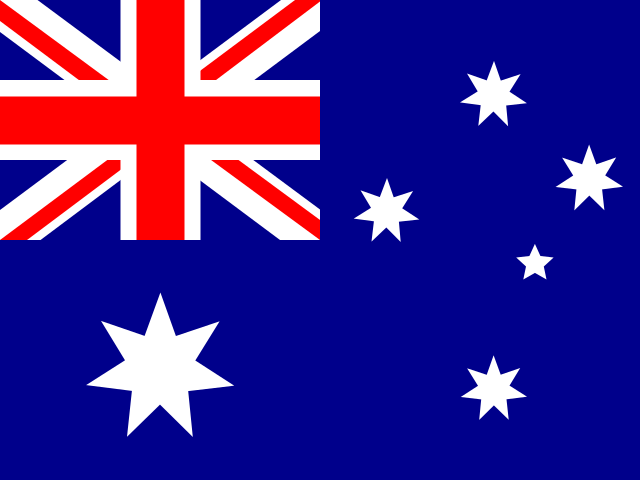
The Australian National Flag is a blue flag with three elements: the Union Jack, the Commonwealth Star and the Southern Cross.
What the symbols mean
- The Union Jack, in the top corner, recalls Australia's history as a group of British colonies and its links to Britain.
- The Commonwealth Star, or Star of Federation, has seven points: six for the original states and one for the territories. When the flag was first chosen in 1901, the star had six points; the seventh was added in 1908.
- The Southern Cross is the most famous constellation of the southern sky and has guided travellers for centuries. Four of its stars have seven points, and the smallest has five.
- The blue field has no official meaning, although the flag is a version of the blue ensign used by British colonies.
Where the flag came from
Soon after Federation in 1901, a national design competition attracted more than 32,000 entries. The judges found five almost identical designs and declared them joint winners, including one by Ivy Evans, a 14-year-old schoolgirl from Melbourne. The winning flag was first flown on 3 September 1901 at the Royal Exhibition Building in Melbourne, and 3 September is now celebrated as Australian National Flag Day.
For decades the red version of the flag was widely flown by ordinary Australians, while the blue one was used by the government. The Flags Act 1953 confirmed the blue flag as the Australian National Flag.
Australia also has two other official flags. The Aboriginal Flag, designed by Luritja artist Harold Thomas and first flown in Adelaide in 1971, is black for the people, red for the earth and their spiritual relationship to it, and yellow for the sun. The Torres Strait Islander Flag, designed by Bernard Namok, features a white dhari, a traditional headdress, and a five-pointed star. Both were proclaimed official flags of Australia in 1995.
Flag facts most people get wrong
- It is easy to confuse with New Zealand's flag, but New Zealand's has four red stars with white borders and no Commonwealth Star, while Australia's has six white stars.
- The stars are not all the same. The Commonwealth Star and four stars of the Southern Cross have seven points, while the smallest star, Epsilon Crucis, has five.
- Green and gold are Australia's national colours, worn by its sports teams, but they do not appear on the national flag.
- The design has been debated. Some Australians would like a flag without the Union Jack, but the current design remains the official national flag.
The Australian people: a fair go for all
Australian identity begins with Aboriginal and Torres Strait Islander peoples, around a million people today, belonging to hundreds of distinct nations and language groups across the continent and the islands of the Torres Strait. Their deep connection to land and sea, and the continuing work of recognition and reconciliation, are central to modern Australia. Acknowledgements of Country, at events large and small, have become a familiar part of national life.
Australia is also a nation of migrants. Around three in ten people living in Australia were born overseas, and many more have a parent who was. Early waves of British and Irish settlers were followed by people from Italy, Greece and the rest of Europe after the Second World War, and more recently by large communities from China, India, Vietnam, the Philippines, the Middle East and New Zealand. Sydney and Melbourne are among the most multicultural cities in the world.
Australians often describe their values with the idea of a fair go: equal opportunity for everyone, whatever their background. Mateship, a relaxed and friendly manner, a love of the outdoors and a dry sense of humour are widely celebrated, and voting in federal elections has been compulsory since 1924, so almost everyone takes part.
Frequently asked questions about Australia
What is Australia most famous for?
Australia is famous for the Sydney Opera House and Harbour Bridge, Uluru, the Great Barrier Reef, its beaches and surf culture, unique wildlife such as kangaroos and koalas, the ancient cultures of Aboriginal and Torres Strait Islander peoples, sport, especially cricket and Australian rules football, and its relaxed outdoor lifestyle.
What do the stars on the Australian flag mean?
The large seven-pointed Commonwealth Star represents the six states and the territories united in the federation, and the five stars on the right form the Southern Cross, a constellation that can be seen from the southern hemisphere. The Union Jack recalls Australia's British colonial history.
What is the capital of Australia?
The capital is Canberra, not Sydney. Canberra was chosen as a compromise between Sydney and Melbourne and purpose-built as the national capital, with Parliament moving there in 1927.
How many states does Australia have?
Australia has six states (New South Wales, Victoria, Queensland, Western Australia, South Australia and Tasmania) and two major mainland territories (the Northern Territory and the Australian Capital Territory).
Is Australia a country or a continent?
Both. Australia is a country, and the mainland is the smallest of the world's continents. Geographers often group it with New Guinea and nearby islands as the continent of Australia, or with the Pacific islands as the region of Oceania.
Why does Australia have three official flags?
Alongside the Australian National Flag, the Aboriginal Flag and the Torres Strait Islander Flag were proclaimed official flags of Australia in 1995. They are often flown together at government buildings and public events.
Own a square of the Australian flag
On 195 Flags, the flag of Australia is being rebuilt one square at a time by Australians at home and around the world. Claim your square for $1.99 and seal a message and a photo inside it: a time capsule for your future self and the generations who come after you. And when the Australian flag is completely filled, one square owner wins $40,000.
Claim your square of the Australian flag →
Photo credits
- Sydney Opera House and Harbour Bridge (cover): DXR, CC BY-SA 4.0, via Wikimedia Commons
- Uluru: Dietmar Rabich, CC BY-SA 4.0, via Wikimedia Commons
- Great Barrier Reef: Ank Kumar, CC BY-SA 4.0, via Wikimedia Commons
- Twelve Apostles: Dietmar Rabich, CC BY-SA 4.0, via Wikimedia Commons
- Bondi Beach: Dietmar Rabich, CC BY-SA 4.0, via Wikimedia Commons
- Three Sisters, Blue Mountains: Dietmar Rabich, CC BY-SA 4.0, via Wikimedia Commons
- Kakadu National Park: Dietmar Rabich, CC BY-SA 4.0, via Wikimedia Commons
- Parliament House, Canberra: Thennicke, CC BY-SA 4.0, via Wikimedia Commons
- Flinders Street Station, Melbourne: Dietmar Rabich, CC BY-SA 4.0, via Wikimedia Commons
- Whitehaven Beach: Hush Neo, CC BY-SA 4.0, via Wikimedia Commons
- Perth from Kings Park: Calistemon, CC BY-SA 4.0, via Wikimedia Commons
- Remarkable Rocks, Kangaroo Island: Dinkum, CC0, via Wikimedia Commons
- Cradle Mountain and Dove Lake: BennyG3255, CC BY-SA 4.0, via Wikimedia Commons
The Australian flag image is from 195flags.com.


,_Uluru-Kata_Tjuta_National_Park,_Uluru_--_2019_--_3688.jpg)
_05.jpg)
,_Port_Campbell_National_Park,_Twelve_Apostles_--_2019_--_0969.jpg)
,_Bondi_Beach_--_2019_--_2354.jpg)
,_Three_Sisters_--_2019_--_1983.jpg)
,_Kakadu_National_Park,_Gunwarrdehwarrde_Lookout_--_2019_--_4118.jpg)

,_Flinders_Street_Railway_Station_--_2019_--_202623.jpg)


