France: What It's Famous For, Iconic Landmarks, Regions, History and the Meaning of the French Flag

France is a country of grand boulevards and tiny hilltop villages, of snowy Alpine peaks, Atlantic surf and Mediterranean beaches, of vineyards, châteaux and cathedrals, and of a way of life that has shaped how much of the world thinks about food, fashion, art and ideas. It is also one of the most visited countries on earth. In this guide we explore what France is famous for, its most distinctive landmarks, the most popular regions and what each one offers, a timeline of French history, and the meaning behind the blue, white and red of the French flag.
France at a glance
- Official name: the French Republic (République française)
- Capital: Paris, by far the largest city; other major cities include Marseille, Lyon, Toulouse and Nice
- Population: around 69 million, including about 67 million in metropolitan France and the rest in overseas departments and territories
- Area: about 550,000 km² in metropolitan France, making it the largest country in the European Union; its roughly hexagonal shape gives it the nickname l'Hexagone
- Language: French; regional languages such as Breton, Basque, Occitan, Alsatian and Corsican are still spoken
- Currency: the euro (€), with the CFP franc used in some Pacific territories
- Regions: 18 regions (13 in metropolitan France and 5 overseas), divided into 101 departments
- Government: a semi-presidential republic, the Fifth Republic, founded in 1958
- National symbols: the tricolour flag, Marianne, the Gallic rooster, the anthem "La Marseillaise" and the motto Liberté, Égalité, Fraternité
- National day: 14 July, known in English as Bastille Day and in France simply as the Fête nationale
- Highest mountain: Mont Blanc (about 4,806 m), on the border with Italy, the highest peak in the Alps
- Longest river: the Loire (about 1,000 km), which flows entirely within France
- Standout facts: thanks to its overseas territories, which stretch from the Caribbean to the Indian Ocean and the Pacific, France spans more time zones than any other country
What is France famous for?
Food and gastronomy
Few countries take food as seriously as France. In 2010 the French gastronomic meal, with its ritual of aperitif, several courses, wine and conversation, was added to UNESCO's list of intangible cultural heritage, and in 2022 the craft and culture of the baguette followed. France produces hundreds of cheeses, from Camembert and Brie to Roquefort and Comté, and gave the world croissants, crêpes, croque-monsieurs, macarons, bouillabaisse, coq au vin and crème brûlée. The Michelin Guide began in France in 1900 as a booklet for motorists, and French cooking techniques still underpin professional kitchens around the world.
Wine and champagne
Wine is part of daily life and national identity. Bordeaux, Burgundy, the Rhône, the Loire and Alsace are among the most famous wine regions on the planet, and only sparkling wine made in the Champagne region under strict rules can be called champagne. France is consistently one of the two largest wine producers in the world, alongside Italy.
Fashion and luxury
Paris has been a capital of fashion since the days of Louis XIV's court. Coco Chanel, Christian Dior, Yves Saint Laurent and Hubert de Givenchy changed how people dressed, and houses such as Chanel, Dior, Hermès and Louis Vuitton remain global names. Paris Fashion Week is one of the "big four" fashion weeks, and French perfume, much of it rooted in the flower fields around Grasse in Provence, is world famous.
Art and architecture
From Gothic cathedrals to the Impressionists, France has shaped Western art. In the 19th century, painters such as Claude Monet, Pierre-Auguste Renoir, Edgar Degas and Paul Cézanne broke the rules of academic painting, and Paris later drew artists from all over the world, including Vincent van Gogh and Pablo Picasso. The Louvre and the Musée d'Orsay hold some of the most famous artworks ever made.
Literature, philosophy and ideas
The French language has carried enormous influence in literature and thought. Molière, Voltaire, Victor Hugo, Alexandre Dumas, Marcel Proust, Albert Camus, Jean-Paul Sartre and Simone de Beauvoir are read worldwide, and France has produced more winners of the Nobel Prize in Literature than any other country. The ideas of the 18th-century Enlightenment and the Declaration of the Rights of Man and of the Citizen of 1789 helped shape modern democracy. French is spoken by more than 300 million people across five continents.
Sport
The Tour de France, first held in 1903, is the world's most famous cycling race and finishes each July in Paris. France has won the football World Cup twice, in 1998 and 2018, and the French Open at Roland-Garros is one of tennis's four Grand Slam tournaments. The 24 Hours of Le Mans has been held since 1923, rugby is passionately followed, especially in the south-west, and Paris hosted the Summer Olympics and Paralympics in 2024, a century after it last staged the Games.
Inventions and discoveries
French inventors and scientists gave the world the hot-air balloon (the Montgolfier brothers, 1783), the stethoscope (René Laennec, 1816), Braille (Louis Braille, who was blind from childhood), photography (pioneered by Nicéphore Niépce and Louis Daguerre) and cinema, launched by the Lumière brothers with their first public screening in Paris in 1895. Louis Pasteur developed pasteurisation and vaccines against rabies and anthrax, and Marie Curie, who was born in Poland and worked in Paris, became the first person to win two Nobel Prizes. France also gave the world the metric system.
Festivals and celebrations
On 14 July, a military parade travels down the Champs-Élysées and fireworks light up the Eiffel Tower. Every May the Cannes Film Festival brings stars to the Riviera, the Fête de la Musique fills streets with free music on 21 June, a tradition that began in France in 1982 and has spread worldwide, and the Festival d'Avignon is one of the world's great theatre festivals. Winter brings the Nice Carnival, Lyon's Festival of Lights and Christmas markets across Alsace.
France's most distinctive landmarks
The Eiffel Tower, Paris
Built by Gustave Eiffel's company for the 1889 World's Fair, which marked the centenary of the French Revolution, the Eiffel Tower was criticised by many Parisian artists and writers when it went up and was only meant to stand for 20 years. It survived partly because it proved useful for radio transmission. At about 330 m tall including its antennas, it was the tallest man-made structure in the world until 1930. Today it welcomes millions of visitors a year, is repainted by hand roughly every seven years, and sparkles with thousands of lights for a few minutes every hour after dark.
The Louvre, Paris

Once a fortress and then a royal palace, the Louvre opened as a public museum in 1793, during the Revolution. It is usually the most visited art museum in the world, with collections spanning ancient Egypt to the 19th century, including the Mona Lisa, the Venus de Milo and the Winged Victory of Samothrace. The glass pyramid designed by the architect I. M. Pei was controversial when it opened in 1989, but it has become one of the best-known symbols of Paris.
Notre-Dame de Paris

Begun in 1163 on the Île de la Cité, Notre-Dame is a masterpiece of Gothic architecture, with flying buttresses, rose windows and carved portals. Victor Hugo's 1831 novel, known in English as The Hunchback of Notre-Dame, helped inspire its restoration in the 19th century. On 15 April 2019 a fire destroyed its roof and spire, shocking people around the world. After five years of painstaking work by craftspeople, including a new spire rebuilt to the 19th-century design, the cathedral reopened in December 2024.
The Palace of Versailles

Louis XIV, the "Sun King", transformed his father's hunting lodge south-west of Paris into one of the grandest palaces in Europe and moved the royal court there in 1682. Its Hall of Mirrors, lined with 357 mirrors, saw the proclamation of the German Empire in 1871 and the signing of the Treaty of Versailles in 1919, which formally ended the First World War. The vast formal gardens, designed by André Le Nôtre, include fountains, a Grand Canal and Marie Antoinette's rustic hamlet. Versailles became a UNESCO World Heritage Site in 1979.
Mont-Saint-Michel, Normandy

Crowned by a Benedictine abbey, this rocky island rises from a vast bay on the border of Normandy and Brittany. According to legend, the Archangel Michael appeared to a local bishop in the 8th century and asked him to build a church on the rock. The bay has some of the strongest tides in Europe, and at high tide the island can be surrounded by the sea. Since 2014, visitors have reached it by a slender footbridge rather than a causeway. Mont-Saint-Michel and its bay have been a UNESCO World Heritage Site since 1979.
The Pont du Gard, Occitanie

Built by the Romans in the 1st century AD, the Pont du Gard carried an aqueduct across the Gardon river as part of a channel about 50 km long that brought water to the city of Nemausus, today's Nîmes. Standing about 49 m high on three tiers of arches, it is one of the tallest Roman aqueduct bridges still standing, and it was built without mortar. It has been a UNESCO World Heritage Site since 1985.
The Cité of Carcassonne, Occitanie

With a double ring of walls and more than 50 towers, the Cité of Carcassonne looks like a fairy-tale fortress. Its defences date from Roman times through the Middle Ages, when it played a part in the crusade against the Cathars. By the 19th century it had fallen into ruin, and the architect Eugène Viollet-le-Duc led a famous, and sometimes debated, restoration that gave the towers their pointed slate roofs. It became a UNESCO World Heritage Site in 1997.
The Arc de Triomphe, Paris
Commissioned by Napoleon in 1806 to celebrate the victories of his armies, the Arc de Triomphe was finally completed in 1836. It stands at the centre of a star of twelve avenues at the top of the Champs-Élysées. Beneath the arch lies the Tomb of the Unknown Soldier from the First World War, where an eternal flame has been rekindled every evening since 1923. Visitors can climb to the roof for one of the best views of Paris.
The most popular regions in France and what they offer
Metropolitan France is divided into 13 administrative regions, but many visitors think in terms of the older, historic regions such as Provence, Normandy, Brittany and Alsace, each with its own landscapes, food and traditions.
Paris and Île-de-France
The capital is one of the most visited cities in the world. Beyond the Eiffel Tower, the Louvre and Notre-Dame, visitors come for the artists' hill of Montmartre and the white domes of the Sacré-Cœur, the Impressionist paintings of the Musée d'Orsay in a former railway station, the banks of the Seine, which are a UNESCO World Heritage Site, and the cafés, markets and bakeries of its neighbourhoods. The wider Île-de-France region includes Versailles, the Renaissance palace of Fontainebleau and Disneyland Paris.
Provence

Provence is a land of lavender, olive groves, vineyards and golden stone villages. The lavender fields of the Valensole plateau are usually in bloom from late June to July, and hilltop villages such as Gordes and Roussillon look out over the Luberon. Avignon is home to the vast Palace of the Popes, where popes lived in the 14th century, Arles has a Roman arena and memories of Van Gogh, and Aix-en-Provence was the home of Cézanne. Marseille, founded by Greek settlers around 600 BC, is often described as the oldest city in France, and nearby the white cliffs and turquoise coves of the Calanques form a national park.
The French Riviera (Côte d'Azur)

The glamorous Mediterranean coast between Saint-Tropez and the Italian border has attracted artists, writers and holidaymakers since the 19th century. Nice, which became part of France in 1860, is known for the seafront Promenade des Anglais, its old town and its colourful markets. Cannes hosts its famous film festival, Antibes and Saint-Paul-de-Vence have strong links with Picasso, Matisse and Chagall, and the perched village of Èze offers spectacular views. The independent Principality of Monaco sits on the same stretch of coast.
Normandy

Normandy is a region of apple orchards, half-timbered farmhouses, cream, cider, calvados and Camembert. Its coast is lined with dramatic scenery, such as the white chalk cliffs and arches of Étretat, which were painted by Monet, and history: on 6 June 1944, Allied troops landed on the D-Day beaches, and today museums and war cemeteries, such as the American Cemetery above Omaha Beach, draw visitors from around the world. Inland, Rouen has a magnificent cathedral and is where Joan of Arc was executed, and Giverny is home to Monet's house and water-lily garden.
Brittany

Jutting out into the Atlantic, Brittany has a strong Celtic identity, its own language, Breton, and a long tradition of music and dance at the fest-noz, or night festival. Its rugged coast includes the extraordinary pink rocks of the Côte de Granit Rose around Ploumanac'h and the walled port of Saint-Malo. At Carnac, more than 3,000 prehistoric standing stones are lined up across the fields. Brittany is also the home of crêpes, galettes made with buckwheat, salted butter caramel and fresh seafood.
The Loire Valley

Known as the "Garden of France", the valley of the Loire is famous for its Renaissance châteaux, and a long stretch of it is a UNESCO World Heritage Site. Chambord, begun in 1519 for King François I, has more than 400 rooms and a famous double-spiral staircase that some believe was inspired by Leonardo da Vinci, who spent his final years nearby at Amboise. Chenonceau spans the River Cher on graceful arches, and Villandry is known for its formal gardens. The region also produces fine wines such as Sancerre and Vouvray, and is ideal for exploring by bicycle.
Alsace

On the border with Germany, Alsace changed hands several times between 1871 and 1945, and its culture blends French and German influences. Strasbourg, with its towering Gothic cathedral and canal-ringed old town, is the official seat of the European Parliament. The Alsace Wine Route winds through villages of half-timbered houses such as Riquewihr, while Colmar's "Little Venice" quarter is one of the most photographed places in France. In December, the region's Christmas markets are among the most famous in Europe.
The French Alps

The French Alps are a paradise for skiers, climbers and hikers. Chamonix, at the foot of Mont Blanc, hosted the first Winter Olympics in 1924, and a cable car climbs to the Aiguille du Midi, at about 3,842 m, for breathtaking views. Resorts such as Val d'Isère, Courchevel and Les Deux Alpes are world famous for skiing, while in summer the clear blue lake of Annecy and the trails around Mont Blanc draw walkers. The French Alps are due to host the Winter Olympics again in 2030.
Lyon and Burgundy
Lyon, one of France's largest cities, is often called the capital of French gastronomy, famous for its traditional restaurants, or bouchons, and for the late chef Paul Bocuse. Its Renaissance old town and Roman theatres are a UNESCO World Heritage Site, and every December the city glows during the Festival of Lights. To the north, Burgundy is renowned for its wines, the medieval Hospices de Beaune, the mustard of Dijon and dishes such as boeuf bourguignon.
Bordeaux and the south-west

The elegant city of Bordeaux, much of which is a UNESCO World Heritage Site, is famous for its 18th-century architecture, the reflecting pool of the Miroir d'eau and its surrounding vineyards, including the medieval village of Saint-Émilion. To the south-west, the Dune of Pilat is the tallest sand dune in Europe, and further south the Basque coast around Biarritz is one of Europe's best-known surfing destinations. Inland, the Dordogne is known for its castles, prehistoric cave art, including Lascaux, which visitors now see through a remarkably detailed replica, and rich food such as foie gras and truffles.
Occitanie
The sunny south of Occitanie stretches from the Pyrenees to the Mediterranean. Toulouse, known as la Ville Rose for its pink brick buildings, is a centre of the European aerospace industry and home to Airbus. The Canal du Midi, built in the 17th century to link the Atlantic and the Mediterranean, is lined with plane trees and is a UNESCO World Heritage Site. The region also includes Carcassonne, the Pont du Gard, the lively university city of Montpellier and the pilgrimage town of Lourdes in the foothills of the Pyrenees.
Corsica

Known as l'Île de Beauté, the Isle of Beauty, Corsica is a mountainous Mediterranean island with its own language and a fiercely proud identity. It became French in 1768, the year before Napoleon Bonaparte was born in its capital, Ajaccio. The town of Bonifacio sits dramatically on white limestone cliffs, the GR20 is considered one of the toughest long-distance hiking trails in Europe, and the island's beaches, such as Palombaggia, have some of the clearest water in France.
A timeline of French history
- c. 450,000 years ago: Early humans live in the south of France; remains known as Tautavel Man are among the oldest found in the country.
- c. 36,000 years ago: People paint lions, horses and rhinos on the walls of the Chauvet Cave in the Ardèche.
- c. 17,000 years ago: The famous paintings of the Lascaux cave in the Dordogne are created.
- c. 4500 BC: Neolithic people begin raising the standing stones of Carnac in Brittany.
- c. 600 BC: Greek settlers from Phocaea found Massalia, today's Marseille.
- 58–50 BC: Julius Caesar conquers Gaul; the Gaulish leader Vercingetorix surrenders at Alesia in 52 BC.
- 1st century AD: The Romans build the Pont du Gard; Roman Gaul flourishes for several centuries.
- Late 5th century: Clovis, king of the Franks, unites much of Gaul and converts to Christianity.
- 732: Charles Martel defeats an Umayyad army between Tours and Poitiers.
- 800: Charlemagne is crowned emperor in Rome on Christmas Day.
- 843: The Treaty of Verdun divides Charlemagne's empire; its western part, West Francia, becomes the basis of France.
- 911: The Viking leader Rollo is granted the lands that become Normandy.
- 987: Hugh Capet becomes king, founding the Capetian dynasty.
- 1066: William, Duke of Normandy, conquers England.
- 1163: Construction of Notre-Dame de Paris begins.
- 1337–1453: The Hundred Years' War is fought between the kings of France and England.
- 1429–1431: Joan of Arc helps lift the siege of Orléans but is captured and burned at the stake in Rouen.
- 1515–1547: King François I brings the Renaissance to France and invites Leonardo da Vinci to the country.
- 1562–1598: The Wars of Religion divide Catholics and Protestants, ending with the Edict of Nantes.
- 1635: The Académie française is founded to guard the French language.
- 1643–1715: Louis XIV reigns for 72 years, moving the court to Versailles in 1682.
- 1789: The storming of the Bastille on 14 July begins the French Revolution; the Declaration of the Rights of Man and of the Citizen follows in August.
- 1792–1793: The monarchy is abolished, the First Republic is proclaimed and King Louis XVI is executed.
- 1794: The tricolour is adopted as the national flag.
- 1804: Napoleon Bonaparte crowns himself emperor and introduces the Civil Code.
- 1815: Napoleon is defeated at Waterloo, and the monarchy is restored.
- 1848: A revolution creates the Second Republic, which abolishes slavery in the French colonies and introduces voting for all adult men.
- 1852–1870: Under Napoleon III's Second Empire, Baron Haussmann rebuilds Paris with wide boulevards.
- 1870–1871: France is defeated in the Franco-Prussian War and loses Alsace and part of Lorraine; the Third Republic is established.
- 1889: The Eiffel Tower opens for the World's Fair.
- 1905: A law separates church and state, the foundation of French laïcité.
- 1914–1918: The First World War devastates northern and eastern France; the Battle of Verdun in 1916 becomes a national symbol of sacrifice.
- 1940–1944: Germany defeats and occupies France; General Charles de Gaulle leads the Free French from London, while the Vichy regime collaborates with the occupiers.
- 1944: Allied forces land in Normandy on 6 June and Paris is liberated in August; women are granted the right to vote, first casting ballots in 1945.
- 1946–1962: Most French colonies become independent, including Algeria in 1962 after a long and painful war.
- 1957: France is a founding member of the European Economic Community, the forerunner of the EU.
- 1958: The Fifth Republic is founded, with de Gaulle as its first president.
- 1968: Student protests and nationwide strikes shake the country in May.
- 1981: The death penalty is abolished.
- 1994: The Channel Tunnel opens, linking France and Britain by rail.
- 1998: France wins the football World Cup on home soil.
- 2002: Euro notes and coins replace the French franc.
- 2015: Paris suffers deadly terrorist attacks in January and November; in December, the Paris Agreement on climate change is adopted.
- 2019: Fire destroys the roof and spire of Notre-Dame de Paris.
- 2024: Paris hosts the Summer Olympic and Paralympic Games, and Notre-Dame reopens in December.
The French flag: its history and meaning
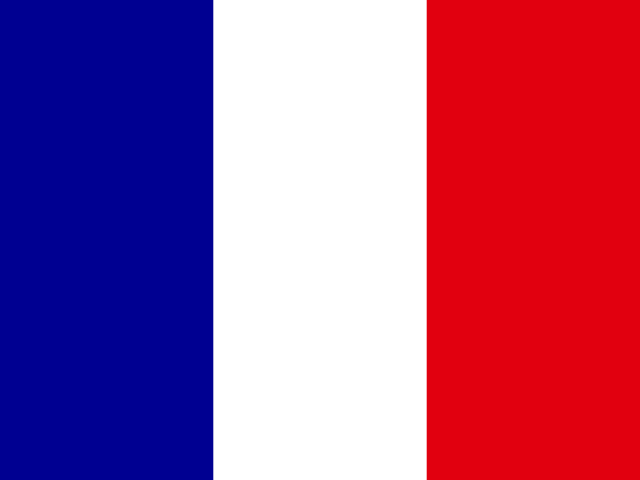
The French flag, known as le drapeau tricolore or simply the tricolour, has three vertical stripes of blue, white and red. Article 2 of the French Constitution names it as the national emblem.
What the colours mean
- Blue and red are the traditional colours of the city of Paris, worn by Parisian revolutionaries in 1789.
- White has long been associated with the French monarchy, and was the colour of the royal flag before the Revolution.
- Together, according to the most common explanation, the colours joined the people of Paris with the king at a moment when the Revolution still hoped to reform the monarchy rather than abolish it.
- Today the three colours are widely linked with the national motto, Liberté, Égalité, Fraternité, although this association is popular rather than official.
Where the flag came from
In July 1789, days after the storming of the Bastille, revolutionaries wore a cockade, a rosette of ribbon, in blue and red. The Marquis de Lafayette, commander of the new National Guard, is traditionally credited with adding royal white to it. The colours soon appeared on flags, and on 15 February 1794 the National Convention made the vertical tricolour, with blue nearest the flagpole, the national flag. The painter Jacques-Louis David is often credited with its design.
When the monarchy was restored after Napoleon's fall, the white royal flag returned from 1814 to 1830, but King Louis-Philippe brought back the tricolour after the July Revolution of 1830. In 1848 revolutionaries briefly called for a red flag, but the poet and politician Alphonse de Lamartine famously defended the tricolour, and it has remained the flag of France ever since, written into the constitutions of 1946 and 1958.
Flag facts most people get wrong
- The blue has changed shade. In 1976 President Valéry Giscard d'Estaing introduced a lighter blue, similar to the flag of the European Union; in 2020 the Élysée Palace quietly returned to a darker navy blue for its own flags, and both shades can still be seen.
- The stripes are not always equal. On the national flag they are the same width, but on the French naval ensign the stripes are slightly different widths so that they look equal when the flag is flying at sea.
- It is not the Dutch or Russian flag on its side. The Netherlands and Russia use horizontal stripes in a different order, while the French stripes are vertical. Italy's flag shares the same layout but uses green instead of blue.
- Blue goes next to the flagpole. When the flag is shown, the blue stripe is always at the hoist, so a French flag hung the "wrong way round" shows red at the pole.
The French people: liberty, equality and the art of living
French identity is closely tied to the ideals of the Republic: liberty, equality and fraternity, a shared language and the principle of laïcité, which keeps religion separate from the state and public institutions. Alongside this national identity, many people feel a strong attachment to their region, whether they are Breton, Basque, Alsatian, Corsican, Provençal or from one of the overseas territories, each with its own traditions, dialects and food.
Modern France is diverse. Over the past century it has welcomed large communities from Italy, Spain, Portugal and Poland, and from North Africa, West Africa, the Caribbean and Southeast Asia, and many French families have roots in more than one country. France's influence also reaches far beyond its borders: French settlers helped shape Quebec and Louisiana, French is an official language in more than 25 countries, and well over a million French citizens live abroad, with large communities in London, Brussels, Geneva, Montreal and New York.
The French are often admired for their art de vivre, the art of living: long meals with family and friends, a fondness for debate, a passion for culture and a belief that quality matters, whether it is a baguette from the local bakery or a well-made wine.
Frequently asked questions about France
What is France most famous for?
France is famous for the Eiffel Tower, the Louvre and Notre-Dame in Paris, the Palace of Versailles and Mont-Saint-Michel, its food, wine, cheese and champagne, its fashion and luxury brands, its art and literature, the Tour de France, and landscapes ranging from the lavender fields of Provence to the Alps and the French Riviera.
What do the colours of the French flag mean?
Blue and red are the traditional colours of Paris, and white was the colour of the French monarchy. According to the most common explanation, the colours were combined in 1789 to unite the people of Paris with the king. Today many people also link the three colours with the motto Liberté, Égalité, Fraternité.
What is the capital of France?
The capital is Paris, which has been the main seat of French kings and governments for most of the past thousand years. Greater Paris is home to more than 12 million people, around one in six of the country's population.
How many regions does France have?
France has 18 regions: 13 in metropolitan France, including Corsica, and 5 overseas: Guadeloupe, Martinique, French Guiana, Réunion and Mayotte. The number of metropolitan regions was reduced from 22 to 13 in 2016.
Why is 14 July France's national day?
14 July marks the storming of the Bastille prison in Paris in 1789, a symbol of the start of the French Revolution, and also the Festival of the Federation held exactly a year later to celebrate national unity. It has been the national holiday since 1880.
Own a square of the French flag
On 195 Flags, the flag of France is being rebuilt one square at a time by people in France and around the world. Claim your square for $1.99 and seal a message and a photo inside it: a time capsule for your future self and the generations who come after you. And when the French flag is completely filled, one square owner wins $40,000.
Claim your square of the French flag →
Photo credits
- Eiffel Tower from the Trocadéro (cover): NonOmnisMoriar, CC BY-SA 3.0, via Wikimedia Commons
- The Louvre: Benh LIEU SONG, CC BY-SA 3.0, via Wikimedia Commons
- Notre-Dame de Paris: Gerda Arendt, CC0, via Wikimedia Commons
- Marble Courtyard, Versailles: Mariejo71, CC BY-SA 3.0, via Wikimedia Commons
- Mont-Saint-Michel: Diliff, Public domain, via Wikimedia Commons
- Pont du Gard: Benh LIEU SONG, CC BY-SA 3.0, via Wikimedia Commons
- Carcassonne: Benh LIEU SONG, CC BY-SA 3.0, via Wikimedia Commons
- Lavender fields, Valensole: Nuno Alves, CC BY-SA 4.0, via Wikimedia Commons
- Nice from Castle Hill: Spike, CC BY-SA 4.0, via Wikimedia Commons
- Étretat cliffs: Jörg Braukmann, CC BY-SA 4.0, via Wikimedia Commons
- Ploumanac'h lighthouse: Stephan Sprinz, CC BY 4.0, via Wikimedia Commons
- Château de Chambord: Benh LIEU SONG, CC BY-SA 3.0, via Wikimedia Commons
- Little Venice, Colmar: Krzysztof Golik, CC BY-SA 4.0, via Wikimedia Commons
- Mont Blanc from the Aiguille du Midi: Christian David, CC BY-SA 4.0, via Wikimedia Commons
- Place de la Bourse, Bordeaux: Gzen92, CC BY-SA 4.0, via Wikimedia Commons
- Bonifacio, Corsica: Isiwal, CC BY-SA 3.0, via Wikimedia Commons
The French flag image is from 195flags.com.


_(4).jpg)
