Canada: What It's Famous For, Iconic Landmarks, Provinces, History and the Meaning of the Canadian Flag

Canada is a country of enormous scale and quiet charm. It stretches from the Atlantic to the Pacific and north to the Arctic Ocean, taking in rugged coastlines, the Rocky Mountains, endless forests, prairies and frozen tundra, as well as some of the most liveable and multicultural cities in the world. In this guide we explore what Canada is famous for, its most distinctive landmarks, the most popular provinces and territories and what each one offers, a timeline of Canadian history, and the meaning behind the red maple leaf on the Canadian flag.
Canada at a glance
- Capital: Ottawa, Ontario; the largest city is Toronto
- Population: around 42 million
- Area: about 9.98 million km², the second-largest country in the world after Russia
- Official languages: English and French
- Currency: the Canadian dollar ($), nicknamed the "loonie" after the bird on the one-dollar coin
- Provinces and territories: 10 provinces and 3 territories
- Government: a parliamentary democracy and constitutional monarchy, with King Charles III as head of state
- National symbols: the maple leaf, the beaver, the anthem "O Canada" and the motto A mari usque ad mare, "from sea to sea"
- National day: Canada Day, 1 July, marking Confederation in 1867
- Highest mountain: Mount Logan, Yukon (about 5,959 m), the highest peak in Canada
- Longest river: the Mackenzie River, which with its upstream river system runs for about 4,240 km to the Arctic Ocean
- Standout facts: Canada has the longest coastline of any country, and its border with the USA, at nearly 8,900 km, is the longest international border in the world
What is Canada famous for?
Vast wilderness and wildlife
Much of Canada is wild country: boreal forest, mountains, tundra and lakes. Canada is often said to have more lakes than any other country, and it protects huge areas in its national parks, starting with Banff in 1885. It is home to moose, beavers, black and grizzly bears, caribou, orcas and belugas, and a large share of the world's polar bears. In the far north, the northern lights dance across the winter sky.
Maple syrup and comfort food
Canada produces most of the world's maple syrup, and the province of Quebec alone makes around 70 per cent of the global supply. Every spring, "sugar shacks" boil sap into syrup and serve it poured over snow as maple taffy. Canada's other favourites include poutine (chips topped with cheese curds and gravy, born in rural Quebec), butter tarts, Nanaimo bars, Montreal bagels and smoked meat, and fresh lobster and seafood from the Atlantic coast.
Ice hockey and sport
Ice hockey is Canada's official national winter sport and close to a national passion, while lacrosse, a game with Indigenous origins, is the official summer sport. Basketball was invented by a Canadian, James Naismith, although he did so in the USA. Canada has hosted the Winter Olympics twice, in Calgary in 1988 and Vancouver in 2010, and co-hosted the 2026 FIFA World Cup with the USA and Mexico, with matches in Toronto and Vancouver.
Inventions and discoveries
Insulin was discovered at the University of Toronto in 1921 by Frederick Banting and Charles Best, with colleagues, transforming the treatment of diabetes. Canadians also gave the world the snowmobile, the IMAX film format, the Canadarm robotic arm used on the Space Shuttle, the board game Trivial Pursuit and, perhaps surprisingly, the Hawaiian pizza, created in Ontario in 1962.
Music, comedy and film
Canada has produced a remarkable roll call of musicians: Joni Mitchell, Leonard Cohen, Neil Young, Céline Dion, Shania Twain, Drake, The Weeknd and Justin Bieber among them. Canadian comedians and actors, from Jim Carrey and Mike Myers to Ryan Reynolds, have long been at home in Hollywood, and the Toronto International Film Festival, founded in 1976, is one of the most important film festivals in the world.
Indigenous cultures
Canada is home to three groups of Indigenous peoples, First Nations, Inuit and Métis, with more than 1.8 million people identifying as Indigenous. Their languages, art, ceremonies and knowledge of the land go back thousands of years, and many Canadian place names, including the name "Canada" itself, come from Indigenous words.
Festivals and winter fun
Canadians embrace the cold. Ottawa's Winterlude festival and the Rideau Canal Skateway, Quebec's Winter Carnival with its ice palace, and the frozen-lake skating rinks of countless small towns make winter something to celebrate. In summer, the Calgary Stampede, first held in 1912, fills the city with rodeo and cowboy hats, and the Montreal International Jazz Festival draws huge crowds.
Multiculturalism
In 1971 Canada became one of the first countries to adopt an official policy of multiculturalism, and more than one in five people living in Canada were born in another country. Cities like Toronto and Vancouver are some of the most diverse on earth.
Canada's most distinctive landmarks
Niagara Falls, Ontario

On the border between Ontario and New York State, Niagara Falls is one of the most famous waterfalls in the world. Most of the great curved Horseshoe Falls, about 57 m high, lies on the Canadian side, which also offers the best views of all three falls. Visitors can ride a boat into the spray at the foot of the falls, walk behind the cascade through tunnels cut into the rock, or see the falls lit up in colour at night.
The CN Tower, Toronto

Completed in 1976, the CN Tower stands about 553 m tall and was the world's tallest free-standing structure for more than 30 years, until it was overtaken by the Burj Khalifa in Dubai. Its glass floor lets visitors look straight down more than 340 m, and the daring EdgeWalk lets them walk, harnessed, around the outside of the tower's main pod.
Banff National Park and Moraine Lake, Alberta
Founded in 1885, Banff is Canada's oldest national park and part of the Canadian Rocky Mountain Parks UNESCO World Heritage Site. Its glacier-fed lakes get their astonishing turquoise colour from fine "rock flour" ground by the ice. Moraine Lake, in the Valley of the Ten Peaks, once appeared on the back of the Canadian $20 note, and nearby Lake Louise is famous for its grand lakeside hotel. To protect the area, the road to Moraine Lake is now closed to private cars, and visitors arrive by shuttle bus, bike or tour.
Château Frontenac and Old Quebec

Rising above the St. Lawrence River, the Château Frontenac opened in 1893 as one of the Canadian Pacific Railway's grand hotels and is often described as one of the most photographed hotels in the world. Around it lies Old Quebec, a UNESCO World Heritage Site of cobbled streets and stone houses, and the only city in North America north of Mexico that still has its fortified walls.
Parliament Hill, Ottawa

Perched on a cliff above the Ottawa River, Canada's Parliament buildings are a masterpiece of Gothic Revival architecture. The original Centre Block burned down in 1916 and was rebuilt, with the Peace Tower completed in 1927. The Centre Block closed in 2019 for a major renovation expected to last into the 2030s, so Parliament currently sits in nearby buildings, but the grounds remain open, and in summer the Changing of the Guard takes place on the lawn.
Peggys Cove, Nova Scotia

The little fishing village of Peggys Cove, about 45 minutes from Halifax, is known for its lighthouse, built in 1915, which sits on great slabs of granite smoothed by glaciers. It is one of the most photographed lighthouses in Canada. The Atlantic waves here can be powerful, so visitors are asked to stay off the dark, wet rocks.
The Bay of Fundy and Hopewell Rocks, New Brunswick

The Bay of Fundy, between New Brunswick and Nova Scotia, has the highest tides in the world, rising and falling by up to about 16 m. At Hopewell Rocks, tall "flowerpot" rock formations topped with trees stand on the seabed at low tide, when visitors can walk on the ocean floor, and become small islands a few hours later.
The Icefields Parkway, Alberta

The Icefields Parkway runs for about 230 km between Lake Louise and Jasper, and is often called one of the most beautiful drives in the world. Along the way are more than 100 glaciers, waterfalls, wildlife and lookouts such as Peyto Lake, whose shape is often compared to a wolf's head. At the Columbia Icefield, visitors can see the Athabasca Glacier up close.
The polar bears of Churchill, Manitoba

The small town of Churchill, on the shore of Hudson Bay, calls itself the "Polar Bear Capital of the World". Every autumn, polar bears gather nearby to wait for the bay to freeze so they can hunt seals on the ice, and visitors watch them safely from specially built tundra vehicles. In summer, thousands of beluga whales swim into the nearby river estuary.
The most popular provinces and territories in Canada and what they offer
Canada is made up of 10 provinces and 3 northern territories, each with its own character. These are the places visitors love most.
Ontario
Ontario is the most populous province, home to nearly two in five Canadians. Toronto, Canada's largest city, offers the CN Tower, lively neighbourhoods such as Kensington Market, world-class museums and food from every corner of the globe; nearly half of its residents were born outside Canada. The capital, Ottawa, has Parliament Hill, national museums and the Rideau Canal, a UNESCO World Heritage Site that becomes a giant skating rink in winter. Beyond the cities lie Niagara Falls and its wineries, the lakes and forests of Algonquin Provincial Park, and the Thousand Islands on the St. Lawrence River.
Quebec

Canada's largest province by area, Quebec is the heart of French-speaking North America, with a culture, cuisine and joie de vivre all its own. Montreal is famous for its festivals, its food, the historic streets of Old Montreal and the dazzling blue-and-gold interior of Notre-Dame Basilica. Quebec City, founded in 1608, is one of the oldest cities in North America. Further afield are the Laurentian Mountains, whale-watching at Tadoussac and the dramatic Percé Rock on the Gaspé Peninsula.
British Columbia

On the Pacific coast, British Columbia combines mountains, rainforest and ocean. Vancouver regularly ranks among the most liveable cities in the world, with its seawall circling the forested Stanley Park, and mountains close enough to ski and sail on the same day. Nearby Whistler co-hosted the 2010 Winter Olympics, the provincial capital Victoria is known for its gardens and harbour, and the remote islands of Haida Gwaii and the Great Bear Rainforest, home of the rare white "spirit bear", protect extraordinary wildlife and Indigenous heritage.
Alberta
Alberta is home to the Canadian Rockies' most famous parks, Banff and Jasper, as well as the Icefields Parkway that links them. Jasper is one of the largest dark-sky preserves in the world and is recovering from a major wildfire in 2024 that damaged part of the town. Calgary hosts the Calgary Stampede every July, Edmonton is the provincial capital, and the badlands around Drumheller and Dinosaur Provincial Park, a UNESCO site, are some of the richest dinosaur fossil beds anywhere.
Nova Scotia

Nova Scotia means "New Scotland", and Scottish and Celtic traditions remain strong, especially on Cape Breton Island, where the Cabot Trail loops for about 300 km past cliffs, beaches and highland forest. The capital, Halifax, has a lively waterfront and a deep maritime history, including links to the Titanic: around 150 of its victims are buried in the city's cemeteries. Peggys Cove and the colourful UNESCO-listed town of Lunenburg are also here, and the lobster is famous.
New Brunswick
Canada's only officially bilingual province, New Brunswick is the home of much of Canada's Acadian French culture. Its biggest draw is the Bay of Fundy, with the Hopewell Rocks and the coastal Fundy Trail Parkway, and it is a good place for whale watching, sea kayaking and tasting fresh seafood in small fishing towns.
Prince Edward Island

Canada's smallest province is a gentle island of farms, beaches and red sandstone cliffs, coloured by iron oxide in the soil. It is the setting of Anne of Green Gables, Lucy Maud Montgomery's 1908 novel, and visitors can explore Green Gables Heritage Place in Cavendish. Charlottetown hosted the 1864 conference that led to Confederation, and since 1997 the island has been linked to the mainland by the 12.9 km Confederation Bridge. PEI is also famous for its potatoes, mussels and oysters.
Newfoundland and Labrador

The last province to join Canada, in 1949, Newfoundland and Labrador has its own time zone, accent and musical traditions. In the capital, St. John's, brightly painted houses climb the hills, and on Signal Hill, Guglielmo Marconi received the first transatlantic wireless signal in 1901. Nearby Cape Spear is the most easterly point of North America outside Greenland. In spring, icebergs drift down "Iceberg Alley", whales feed offshore in summer, and two UNESCO sites stand out: the fjords of Gros Morne National Park and L'Anse aux Meadows, where Norse explorers settled about a thousand years ago.
Manitoba and Saskatchewan: the Prairies
The Prairie provinces are a land of wide skies, wheat fields and lakes. In Manitoba, Winnipeg is home to the Canadian Museum for Human Rights and The Forks, a meeting place of rivers used by Indigenous peoples for thousands of years, while Churchill offers polar bears and belugas. Saskatchewan has more than 100,000 lakes, the grasslands and badlands of Grasslands National Park, and, in Regina, the RCMP Heritage Centre telling the story of the famous red-coated "Mounties".
The North: Yukon, Northwest Territories and Nunavut
Canada's three territories cover around 40 per cent of the country but are home to only around 130,000 people. In Yukon, Dawson City recalls the Klondike Gold Rush of the 1890s, and Mount Logan rises in Kluane National Park. The Northwest Territories offer some of the best northern lights viewing in the world around Yellowknife, and Great Slave Lake, the deepest lake in North America. Nunavut, created in 1999 as a territory with an Inuit majority, is a land of Arctic islands, fjords and Inuit art.
A timeline of Canadian history
- At least 12,000 years ago: The ancestors of today's Indigenous peoples are living in the land now called Canada, and possibly far earlier.
- c. 1000: Norse explorers from Greenland build a settlement at L'Anse aux Meadows in Newfoundland; wood cut there has been dated to 1021.
- 1497: John Cabot, sailing for England, reaches the coast of Newfoundland or Cape Breton.
- 1534–1535: Jacques Cartier explores the Gulf of St. Lawrence for France; he records the Iroquoian word kanata, "village", which gives Canada its name.
- 1608: Samuel de Champlain founds Quebec City, the heart of New France.
- 1670: The Hudson's Bay Company is founded to trade furs.
- 1755–1764: Thousands of Acadians are deported by the British from Nova Scotia, an event remembered as the Great Upheaval.
- 1759: British forces defeat the French at the Battle of the Plains of Abraham outside Quebec City.
- 1763: The Treaty of Paris transfers New France to Britain.
- 1780s: Tens of thousands of Loyalists who sided with Britain in the American Revolution settle in British North America.
- 1812–1815: The War of 1812 is fought between Britain and the USA; American invasions of Canada are repelled.
- 1837–1838: Rebellions in Upper and Lower Canada call for political reform.
- 1864: The Charlottetown and Quebec conferences plan a union of the colonies.
- 1867: On 1 July, Confederation creates the Dominion of Canada from Ontario, Quebec, Nova Scotia and New Brunswick; John A. Macdonald becomes the first prime minister.
- 1870: Manitoba joins Canada after the Red River Resistance led by Louis Riel.
- 1871–1873: British Columbia and Prince Edward Island join; the North-West Mounted Police, forerunner of the RCMP, is founded.
- 1876: The Indian Act is passed, governing many aspects of First Nations people's lives.
- 1880s–1996: The residential school system separates around 150,000 Indigenous children from their families; the last school closes in 1996.
- 1885: The Canadian Pacific Railway is completed from coast to coast, and Banff becomes Canada's first national park.
- 1896: Gold is discovered in the Klondike, Yukon, sparking a gold rush.
- 1905: Alberta and Saskatchewan become provinces.
- 1914–1918: Canada fights in the First World War; the Battle of Vimy Ridge in April 1917 becomes a defining national moment.
- 1917: The Halifax Explosion, caused by the collision of a munitions ship, devastates part of the city.
- 1918: Most women win the right to vote in federal elections.
- 1921: Insulin is discovered at the University of Toronto.
- 1929: In the "Persons Case", women are legally recognised as persons who can be appointed to the Senate.
- 1931: The Statute of Westminster gives Canada full legislative independence.
- 1939–1945: Canada fights in the Second World War; Canadian troops land on Juno Beach on D-Day in 1944.
- 1949: Newfoundland joins Canada as the tenth province.
- 1960: First Nations people gain the right to vote in federal elections without giving up their status.
- 1965: The red maple leaf flag is raised for the first time on 15 February.
- 1967: Canada celebrates its centennial, and Montreal hosts Expo 67.
- 1969: The Official Languages Act makes English and French equal in the federal government.
- 1976: Montreal hosts the Summer Olympics, and the CN Tower opens in Toronto.
- 1980: "O Canada" becomes the official national anthem; Quebec holds its first referendum on sovereignty.
- 1982: The Constitution is brought home from Britain, along with a new Charter of Rights and Freedoms.
- 1988: Calgary hosts the Winter Olympics.
- 1995: Quebec votes narrowly to remain in Canada in a second referendum.
- 1999: Nunavut becomes Canada's newest territory.
- 2005: Canada legalises same-sex marriage nationwide.
- 2008: The federal government formally apologises for residential schools, and the Truth and Reconciliation Commission begins its work.
- 2010: Vancouver and Whistler host the Winter Olympics.
- 2017: Canada marks 150 years since Confederation.
- 2025: Mark Carney succeeds Justin Trudeau as prime minister.
- 2026: Canada co-hosts the FIFA World Cup with the USA and Mexico.
The Canadian flag: its history and meaning
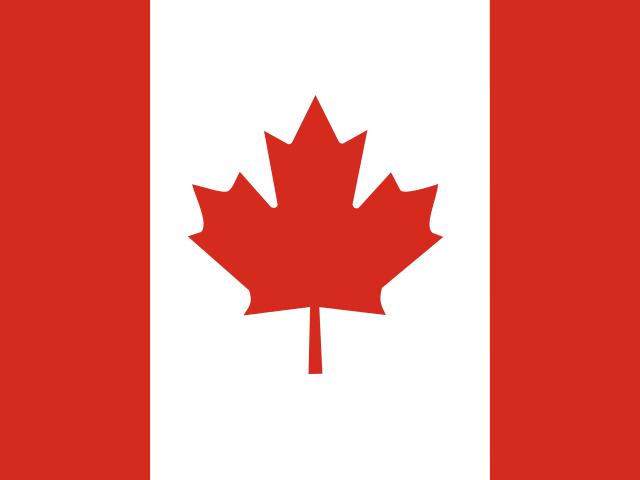
The National Flag of Canada, often called the Maple Leaf or, in French, l'Unifolié, is one of the simplest and most recognisable flags in the world: a red maple leaf on a white square, with a red band on either side.
What the colours and symbols mean
- The maple leaf has been a symbol of Canada since at least the 19th century. Maple trees grow across the country, and the leaf appeared on coins, military badges and the coat of arms long before the flag was created. The leaf on the flag is stylised and does not represent one particular species.
- Red and white were proclaimed Canada's official colours by King George V in 1921. The flag itself was not given an official meaning, but red is often linked to the sacrifice of Canadians in the world wars, and white to the country's snowy north.
- The two red bands are sometimes said to stand for the Pacific and Atlantic oceans, echoing the motto "from sea to sea". This is a popular interpretation rather than an official one.
Where the flag came from
For almost a century after Confederation, Canada had no distinctive national flag of its own. The Union Jack and a version of the British Red Ensign, with the Canadian coat of arms, were flown instead. In 1964, Prime Minister Lester B. Pearson proposed a new flag, which led to months of fierce argument in Parliament known as the Great Flag Debate. Pearson's own favourite, nicknamed the "Pearson Pennant", showed three red maple leaves between blue bands.
A parliamentary committee eventually chose a design inspired by historian George Stanley, based on the flag of the Royal Military College in Kingston. Queen Elizabeth II proclaimed it on 28 January 1965, and it was raised on Parliament Hill for the first time on 15 February 1965. Since 1996, that date has been celebrated as National Flag of Canada Day.
Flag facts most people get wrong
- The leaf has 11 points, not 13. Early designs had more points, but the 11-point leaf was chosen partly because it looked clearer when the flag was flapping in the wind.
- The proportions are unusual. The flag is twice as long as it is high, and the white centre is a perfect square, a feature known as the "Canadian pale".
- The flag is younger than many people think. Canada went almost 100 years after Confederation before adopting a flag of its own in 1965.
- Flags from the Peace Tower are given away. The flag above Parliament is changed regularly, and Canadians can ask to receive one, but the waiting list is so long that new requests may take many decades to be filled.
The Canadian people: diverse, bilingual and connected to the land
Canadian identity has been shaped by many peoples. First Nations, Inuit and Métis communities were here for thousands of years before Europeans arrived, and their cultures, languages and rights are an important part of national life, as is the ongoing work of reconciliation. French and British settlers laid down the country's two official languages, and around one in five Canadians speaks French as a first language, most of them in Quebec, where a strong francophone identity thrives.
Over the past century and a half, immigrants from every corner of the world have made Canada one of the most diverse countries on earth, with large communities with roots in China, India, the Philippines, Italy, the Caribbean, the Middle East and many other places. Canadians often describe their country as a mosaic rather than a melting pot, where people keep their heritage while sharing a common identity.
Canadians value public healthcare, peace-keeping, the outdoors and a good sense of humour, especially about the weather. Whether gathering for Canada Day fireworks, cheering at a hockey game or heading to a cottage by the lake in summer, many Canadians feel a deep connection to the land itself.
Frequently asked questions about Canada
What is Canada most famous for?
Canada is famous for its vast wilderness and national parks, Niagara Falls, the Rocky Mountains, maple syrup and poutine, ice hockey, its wildlife, including moose and polar bears, its multicultural cities such as Toronto, Montreal and Vancouver, and its red maple leaf flag.
What do the colours of the Canadian flag mean?
Red and white are Canada's official colours, proclaimed in 1921. They were not given an official meaning on the flag, but red is often associated with sacrifice in the world wars and white with Canada's snowy landscapes. The maple leaf is a long-standing symbol of Canada and its people.
How many provinces and territories does Canada have?
Canada has 10 provinces (Ontario, Quebec, Nova Scotia, New Brunswick, Manitoba, British Columbia, Prince Edward Island, Saskatchewan, Alberta, and Newfoundland and Labrador) and 3 territories (Yukon, the Northwest Territories and Nunavut).
What is the capital of Canada?
The capital is Ottawa, in Ontario. Queen Victoria chose it in 1857, partly because it sat on the border between English-speaking and French-speaking Canada. Toronto is the largest city.
Is Canada bigger than the USA?
Yes, by total area. Canada covers about 9.98 million km², making it the second-largest country in the world after Russia. The USA has a slightly larger land area, because so much of Canada is covered by lakes and rivers.
What languages are spoken in Canada?
English and French are the two official languages. English is the most widely spoken, French is the majority language in Quebec, and dozens of Indigenous languages, as well as many immigrant languages, are also spoken.
Own a square of the Canadian flag
On 195 Flags, the flag of Canada is being rebuilt one square at a time by Canadians at home and around the world. Claim your square for $1.99 and seal a message and a photo inside it: a time capsule for your future self and the generations who come after you. And when the Canadian flag is completely filled, one square owner wins $40,000.
Claim your square of the Canadian flag →
Photo credits
- Moraine Lake, Banff National Park (cover): Gorgo, Public domain, via Wikimedia Commons
- Horseshoe Falls, Niagara Falls: Helen Filatova, CC BY 2.0, via Wikimedia Commons
- Toronto skyline and CN Tower: Maksim Sokolov (maxergon.com), CC BY-SA 4.0, via Wikimedia Commons
- Château Frontenac, Quebec City: Wilfredor, CC0, via Wikimedia Commons
- Parliament Hill, Ottawa: Óðinn, CC BY-SA 2.5 ca, via Wikimedia Commons
- Peggys Cove lighthouse: Taxiarchos228, CC BY-SA 3.0, via Wikimedia Commons
- Hopewell Rocks, Bay of Fundy: Dennis G. Jarvis, CC BY-SA 2.0, via Wikimedia Commons
- Peyto Lake: Tobias Alt, CC BY-SA 4.0, via Wikimedia Commons
- Polar bear, Churchill: TravelingOtter from Houston, Texas, USA, CC BY 2.0, via Wikimedia Commons
- Notre-Dame Basilica, Montreal: Diliff, CC BY-SA 3.0, via Wikimedia Commons
- Vancouver from Stanley Park: Ueutyi, CC BY-SA 4.0, via Wikimedia Commons
- Cabot Trail, Cape Breton: Elviroyage, CC BY-SA 4.0, via Wikimedia Commons
- Red cliffs, Cavendish, Prince Edward Island: chensiyuan, CC BY-SA 4.0, via Wikimedia Commons
- St. John's from Signal Hill: Michel Rathwell from Cornwall, Canada, CC BY 2.0, via Wikimedia Commons
The Canadian flag image is from 195flags.com.


.jpg)

.jpg)


.jpg)